Most Meta accounts don't stall because they run out of budget capacity. They stall because they apply $50k tactics to a $250k account and wonder why CPAs drift. The $50k to $500k/mo path has three distinct phase changes, and each one requires a different restructuring — not a louder version of what you were already doing. This use case walks you through the exact exit criteria for each phase, so you know when to restructure and what to restructure first.
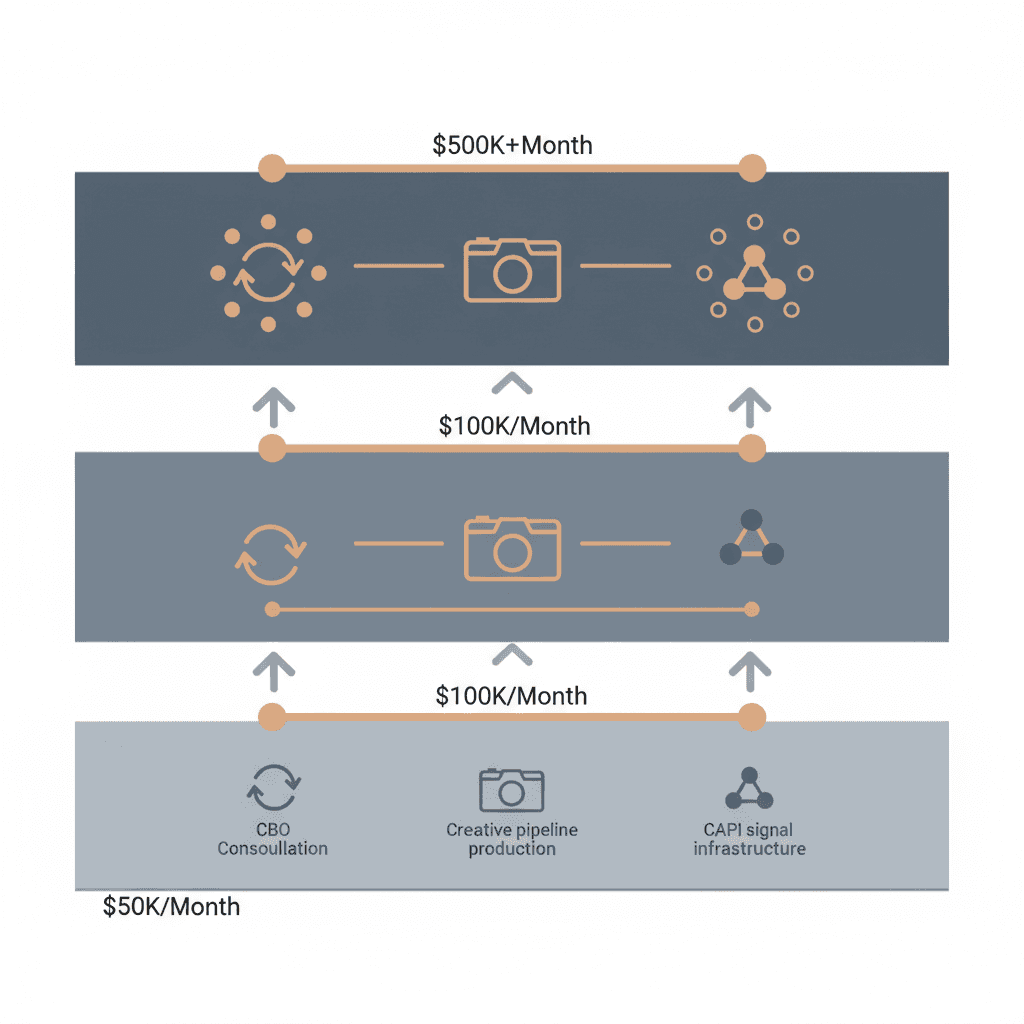
DTC operators and agency leads scaling Meta spend through the $100k/mo, $250k/mo, and $500k/mo thresholds — where each step changes which mistakes hurt most.
If you're running $50k/mo and want a defensible path to $500k, this is built for you. If you're already at $200k and spend-scaling feels like it's stalled, the Phase 2 restructuring section explains why. We've run accounts through all three thresholds, and the failure modes at each are distinct enough that a single playbook doesn't cover them. See the related post on Meta ad budget optimization strategies for context on where this fits in the broader stack.
The $50k to $500k/mo path has three distinct phase changes, not a smooth ramp. Tactics that work at $50k actively break at $250k.
Most accounts hit a ceiling because they scale spend linearly without restructuring at the phase transitions. The learning phase resets accumulate. ABO ad sets fragment into dozens of under-powered units. Attribution stack debt compounds silently — event match quality (EMQ) erodes to 6.8, then 6.1, and no one connects the dots until ROAS reads 30% lower than actuals.
The $250k wall is where most accounts stall. They're running Advantage+ Audience on everything because the platform nudged them that direction. Creative is what the creative team handles. And CAPI is "set up" — meaning someone installed the Shopify native integration two years ago and never checked the pixel deduplication rate.
We covered the attribution failure pattern in more detail in our post on difficult-to-track ad attribution. The spend-scaling problem is a direct consequence: unreliable signal makes every scaling decision a guess. Each phase has a different constraint. Misdiagnose the constraint and you're optimizing the wrong variable.
Scaling Meta spend 10x requires restructuring at two specific thresholds: $100k/mo and $250k/mo. Treat the roadmap as three phases with explicit exit criteria, not a continuous curve.
Phase 1 is about signal health and consolidation. Fragmented ABO structure means no individual ad set clears the 50 events/week floor for Learning Phase completion. Fix the structure first, verify attribution window settings, and confirm your server-side tracking is actually passing clean data before you add a dollar of spend.
Phase 2 is the structural transition. Winners from Phase 1 move into CBO. The creative testing matrix runs in parallel — not mixed into the main account. CAPI gets hardened with active monitoring. An EMQ below 7.5 at this stage is a material risk. This is where most scaling attempts stall: the infrastructure for Phase 3 wasn't built during Phase 2.
Phase 3 is about throughput. The constraint is no longer budget or structure — it's creative velocity and audience saturation. Weekly briefs, weekly shoots, weekly publishes. Track saturation across major pools. Monthly P&L within 5%. The 666 rule is a useful heuristic for managing creative volume at this stage.
The four-layer framework for Meta AI systems in this post on Facebook ads AI platforms is useful context for how algorithmic automation fits into a spend-scaling architecture. The accounts that reach $500k/mo and hold ROAS aren't running more tactics. They're running the right phase-appropriate one.
A defensible 9–12 month spend-scaling path with two explicit phase transitions instead of one slow climb to a ceiling.
ROAS holds within 15% of the $50k baseline through $500k because the attribution stack stays clean — EMQ above 7.5, deduplication monitored, creative refresh cadence codified before angles fatigue. The creative pipeline does not become the bottleneck at Phase 3 because you built the production infrastructure in Phase 2, not when you needed it.
Use adlibrary's ad timeline analysis to benchmark how long comparable accounts run their creative before rotating — that tells you whether your refresh targets are realistic or aspirational.
