Pixel Deduplication is the process of preventing Meta from double-counting the same conversion event when it arrives from both the browser pixel and the server-side Conversions API.
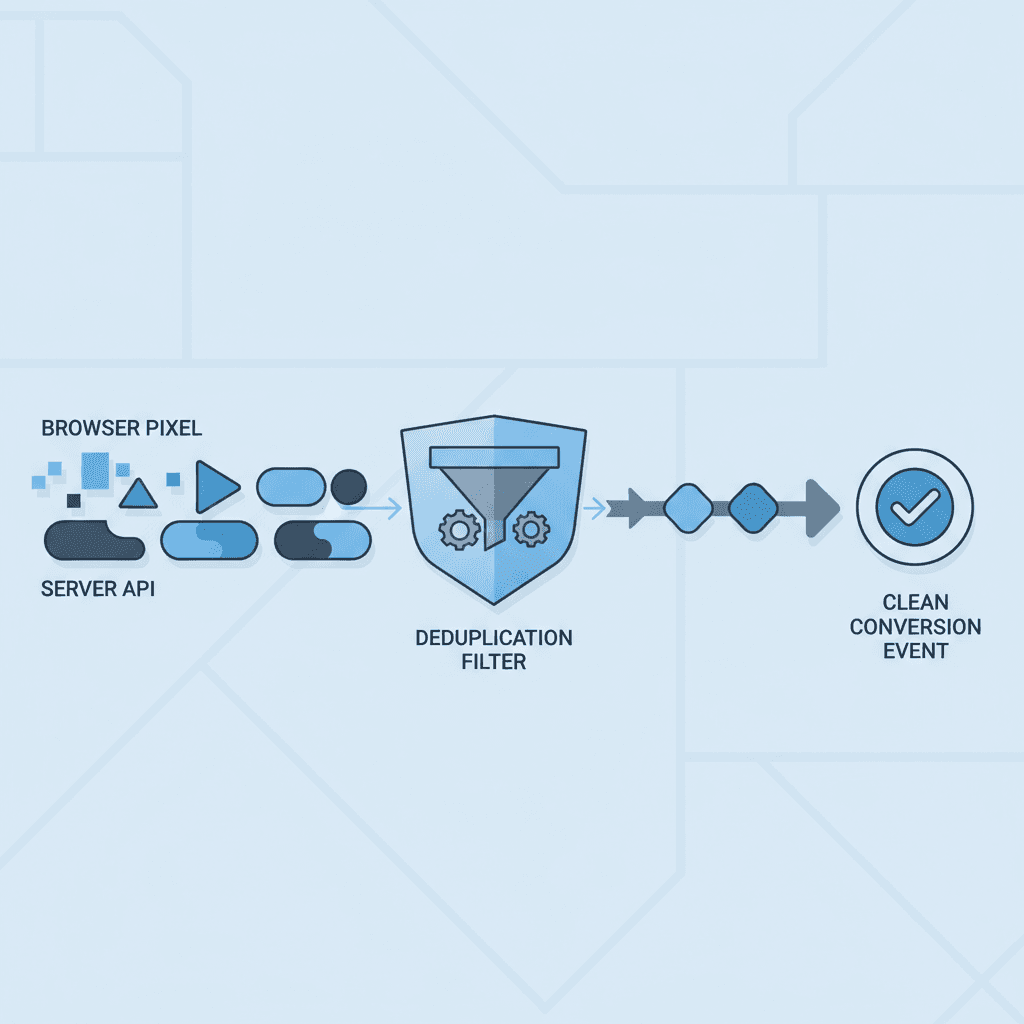
Pixel Deduplication is the process by which Meta merges identical conversion events sent by two different tracking mechanisms — the browser-side pixel and the server-side Conversions API (CAPI) — into a single counted event, preventing double-counting in your reported data.
The mechanism relies on two matching parameters: event_name and event_id. When both the pixel and CAPI fire for the same user action (say, a Purchase), both calls must carry the same event_name (in this case, "Purchase") and the same event_id — a unique identifier you generate per conversion instance, typically a UUID. Meta's ingestion layer compares incoming events within a short deduplication window (roughly 60 minutes) and collapses matched pairs into one. If the event_id differs between pixel and CAPI — or if event_name doesn't match — both events count separately.
Without deduplication, every CAPI implementation inflates conversion counts. Running both pixel and CAPI without matching event_id means a single Purchase fires twice: once from the browser and once from your server. Reported CPA drops, ROAS climbs, and the ad account optimizes toward phantom conversions. We've seen accounts lose weeks of optimization history before the inflation was caught. See how to set up CAPI correctly for retargeting campaigns for a step-by-step walkthrough of event_id handling in practice.
In 2025–2026, with Meta's Andromeda delivery system placing heavier weight on precise attribution signals, clean deduplication is more important than before. Andromeda's auction modeling relies on the quality of the conversion signal it receives — inflated Purchase events from deduplication failures distort the training signal for Advantage+ and broad-targeting campaigns alike.
For accounts using the adlibrary API to automate event monitoring or pull performance data, clean deduplication is the prerequisite for any downstream analysis to mean anything.
The signal is only as clean as the event_id matching — verify both sides of the pipe, not just one. For a practical integration overview, see Meta Ads Integrations That Actually Matter.
Without deduplication, every CAPI implementation inflates conversion counts and corrupts CPA reads. The fix is small — a matching event_id and event_name on both pixel and CAPI — but the cost of skipping it is silent and persistent. Many accounts run for months on double-counted Purchase data before anyone checks the deduplication rate in Events Manager.
