Server-Side Tracking sends conversion events to Meta and other ad platforms from your server rather than from the user's browser, bypassing browser-side blockers and iOS signal loss.
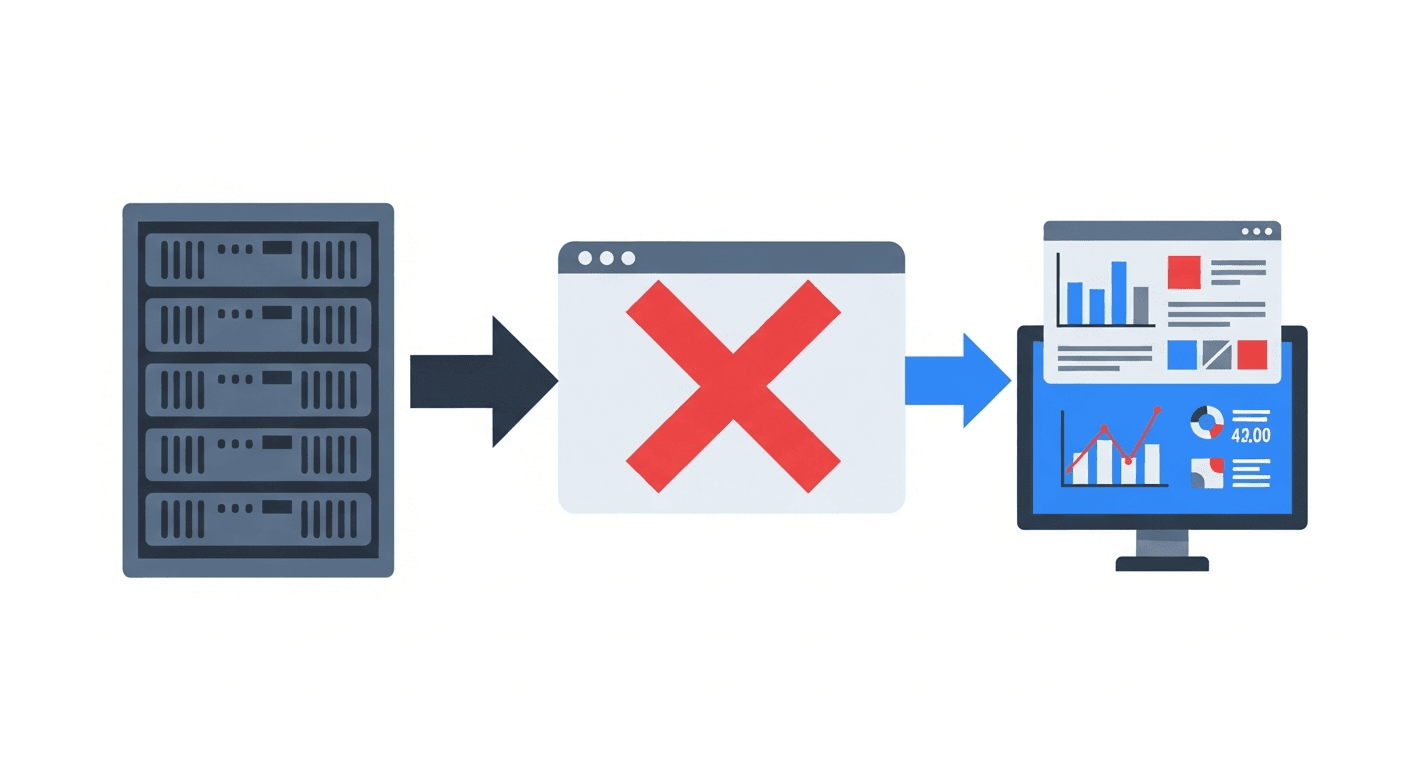
Server-side tracking routes conversion events from your own server to Meta and other ad platforms, rather than relying on a browser-fired pixel to report user actions. The distinction sounds small. The performance difference is not.
The mechanism works like this: when a user completes a purchase, submits a form, or reaches a checkout step, your server — not the user's browser — sends that event directly to Meta via the Conversions API (CAPI). Because the event originates server-side, it bypasses Safari's Intelligent Tracking Prevention, iOS ATT opt-out prompts, third-party cookie blocks, and browser-based ad blockers entirely. The signal lands clean regardless of what the user's device or browser is doing.
In practice, most "server-side" setups are not truly server-side. CAPI implementations that relay browser events through a backend — rather than generating them from actual server-state like a purchase database record — preserve the same signal loss they were meant to fix. True server-side tracking means the event source of truth is your server data: a confirmed order in your database, a lead captured in your CRM, a webhook from your payment processor. That data has no iOS dependency and no ad blocker exposure.
The 2025–2026 Meta delivery context makes this mandatory, not optional. Andromeda's delivery intelligence and Advantage+ campaigns both calibrate on event volume and match quality. An account running pixel-only attribution in an iOS-heavy vertical — fitness, beauty, consumer apps — is feeding a degraded signal into an increasingly signal-sensitive optimization system. We've seen accounts add true server-side tracking and watch retargeting audience sizes grow 25–45% within 30 days, simply because CAPI events surface users the pixel never saw. First-party data collected on your own infrastructure is the durable layer here — hashed email and phone passed with each CAPI event lift Event Match Quality (EMQ) scores and expand your attribution coverage independent of what platform policies do next.
For a practical integration breakdown, Meta Ads integrations that actually matter covers which CAPI setups restore signal versus which ones just move the same browser-relayed data through a server wrapper. Meta API integration software maps the tooling landscape if you're evaluating what to build versus buy.
The practitioner principle: the quality of your server-side events determines the quality of your ad optimization — garbage in, garbage out, regardless of what the platform dashboard reports.
Pixel-only setups have been losing attribution fidelity year on year since iOS 14.5. Server-side tracking is the structural fix — not a nice-to-have. I've audited accounts where adding true CAPI integration lifted reported purchase events by 20–35% and restored retargeting audiences that had quietly shrunk to half their actual size. At any meaningful spend level, the signal gap translates directly to budget wasted on underperforming optimization.
