The Learning Phase is the Meta ads system's exploration period, ending after roughly 50 optimization events in 7 days, during which performance is volatile and unrepresentative.
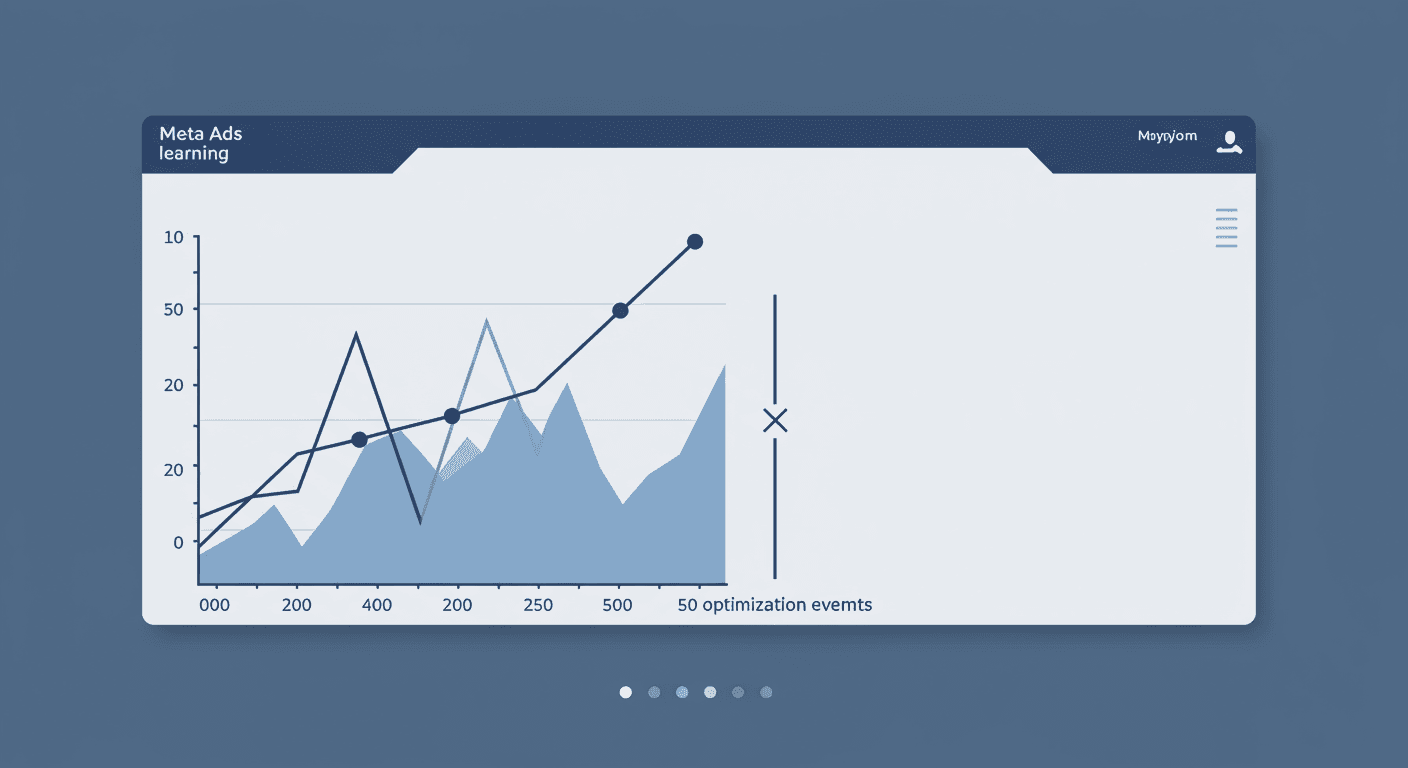
When Meta launches or significantly edits an ad set, the delivery system enters a period of exploration — testing audiences, placements, times, and creative combinations to find the most efficient path to your optimization event. That exploration window is called the learning phase, and it ends once the ad set records approximately 50 optimization events within a rolling 7-day window.
During this period, your cost per result will fluctuate more than usual. That is not dysfunction — it is the algorithm doing exactly what it should: sampling the distribution before narrowing to the highest-signal patterns. CPAs in learning phase can run 30–60% above eventual steady-state, which is why the cost-per-acquisition (CPA) numbers you see on day 3 have almost no predictive value.
The mechanism changed meaningfully after iOS 14. With browser-level signal degraded, Meta's system now relies more heavily on conversion API (CAPI) and modeled data to accumulate those 50 events — meaning lower-budget or higher-CPA ad sets frequently land in "Learning Limited" status, unable to exit because the signal volume never arrives. Under Advantage+ campaigns and Meta's Andromeda delivery architecture, account-level consolidation has become the practical fix: fewer, better-budgeted ad sets each capable of clearing the threshold within a week.
Understanding learning phase is also inseparable from campaign structure: every structural edit — budget change above 20%, audience swap, placement toggle, creative swap — resets the counter. The broad targeting shift Meta has pushed since 2024 is partly a response to this: fewer targeting constraints means more eligible auctions, faster event accumulation, faster learning phase exit.
When we reviewed patterns across thousands of in-market ad accounts on adlibrary, accounts running more than 8 active ad sets per $1,000/day of budget almost never cleared learning phase cleanly — the budget was too diluted per ad set to hit 50 events in 7 days. If you are choosing a Meta ads management tool, look for one that surfaces learning-phase status per ad set — not just aggregate delivery — so you catch "Learning Limited" before it drains a full day of budget. For a deeper look at how ai ad campaign automation affects learning phase cycles, that post covers the tradeoffs of automation-triggered edits.
Treat learning phase exit as a precondition, not a milestone. Don't optimize before it clears.
Most account-level CPA chaos is learning-phase volatility misread as real signal. A CPA spike on day 2 is not a failing ad — it is the algorithm sampling the space. Decisions made before exit corrupt the next 30 days of optimization: you kill a winner before it converges, reset the counter with an edit, and spend the next week re-learning what you just destroyed. The rule is simple: touch nothing until 50 events clear.
