In April 2021, iOS 14.5 shipped App Tracking Transparency and removed deterministic cross-app tracking for roughly 70% of iOS users. Most Meta advertisers watched their attribution dashboard hollow out and never rebuilt the underlying signal stack — they just stopped trusting the numbers. This use case walks through the 5-layer attribution rebuild sequence: from pixel audit to server-side CAPI, EMQ tuning, offline conversions, and modeled attribution. You leave with a defensible new baseline and an audit cadence to keep it clean.
Media buyers, growth leads, and marketing engineers who watched their attribution dashboard collapse after iOS 14.5 hit in April 2021 — and have been making decisions on degraded signal ever since.
If you manage Meta campaigns and your event match quality (EMQ) score is below 7.0, or you've never audited your pixel deduplication rate, this use case is your starting point. Read the EMQ score before you read CPA — that's the standard this guide is written to.
Apple's App Tracking Transparency (ATT) framework, shipped in iOS 14.5, required opt-in for cross-app tracking. Industry opt-in rates settled around 20–30%, which removed deterministic Meta-side visibility for the majority of iOS users.
Pixel-only attribution fell from a 90%+ deterministic floor to a modeled 50–60% best case. SKAdNetwork provided aggregate install data for app advertisers but offered nothing for web conversion tracking. The post-iOS 14 attribution gap is structural — it doesn't heal itself.
Most brands reacted by lowering trust in the dashboard rather than rebuilding the underlying signal. Five years on, many accounts still run on that degraded baseline — making budget allocation decisions on numbers that systematically undercount actual conversions. The platform isn't broken; the instrumentation is. Those are different problems with different fixes.
See how Meta Ads integrations have evolved to address this gap.
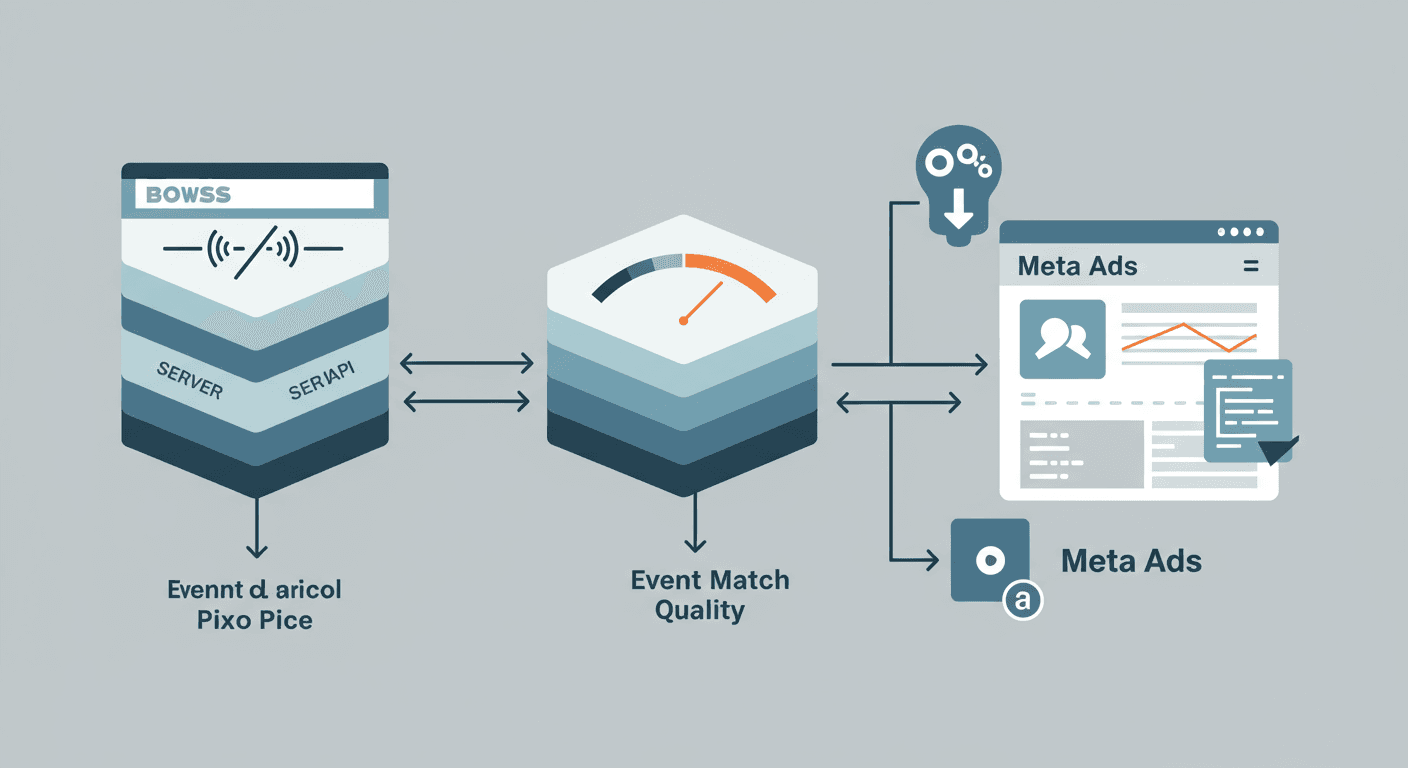
Post-iOS 14 attribution rebuild is a 5-layer stack: pixel for browser-side baseline, server-side tracking via CAPI for signal recovery, event match quality (EMQ) tuning for match accuracy, offline conversions for considered-purchase signals, and modeled conversions for the unobservable remainder. Skip any layer and the floor stays broken.
I've rebuilt this stack three times since 2021 — once after a replatform broke the pixel, once after a botched CAPI integration inflated conversions by 40%, and once from scratch after inheriting an account where nobody had touched the events setup in two years. Each time, the sequence matters. Start with pixel health, not CAPI. You cannot tune what you haven't measured.
The adlibrary API access layer sits downstream of the attribution rebuild — you need clean signal before ad intelligence has anything to anchor to. Fix the attribution infrastructure first, then use the data layer to benchmark creative and spend decisions against what's actually working in market.
Our take: EMQ 7.5+ on server-side events is the defensible floor. Below that, your campaign optimization signals are too noisy to trust. Read more on AI ad campaign automation explained for how clean signal feeds downstream automation. Also see the attribution window glossary entry for how window settings interact with the rebuilt stack.
Recovery of 50–70% of pre-iOS 14 deterministic signal, event match quality at 7.5+ on all server-side events, pixel deduplication rate under 5%, and a CPA read stable enough to make scaling decisions on.
This post-iOS 14 attribution rebuild, when executed in full, gives you a defensible new baseline: one your stakeholders can trust, your algorithm can optimize against, and your team can act on without hedging every number. For a broader look at how meta API integration software fits into this stack, see our dedicated post.
Once the attribution rebuild stack is clean, ad timeline analysis becomes genuinely useful — you can start making creative decisions against a baseline that reflects actual conversion behavior. See how AI for social media advertising uses this signal quality as input.
Why did iOS 14 break Facebook ads attribution?
iOS 14.5 introduced App Tracking Transparency (ATT), which requires user opt-in for cross-app tracking. Industry opt-in rates settled around 20–30%, removing deterministic Meta-side visibility for the majority of iOS users. Any attribution stack relying on pixel alone is measuring a fraction of actual conversions.
What is the most important layer in the post-iOS 14 attribution rebuild?
Server-side CAPI with high Event Match Quality (EMQ). It is the durable layer that compensates for browser-side signal loss across iOS, Safari, and ad-blocker traffic. The rest of the stack builds on top of it.
Will my CPA return to pre-iOS 14 numbers after the attribution rebuild?
No. The signal floor is structurally lower. The goal is a stable, defensible new baseline — not a return to deterministic 90%+ attribution. Set stakeholder expectations accordingly before you start.
