SKAdNetwork (SKAN) is Apple's privacy-preserving attribution framework for iOS app installs, sending Meta limited, delayed, and aggregated conversion signals instead of user-level data.
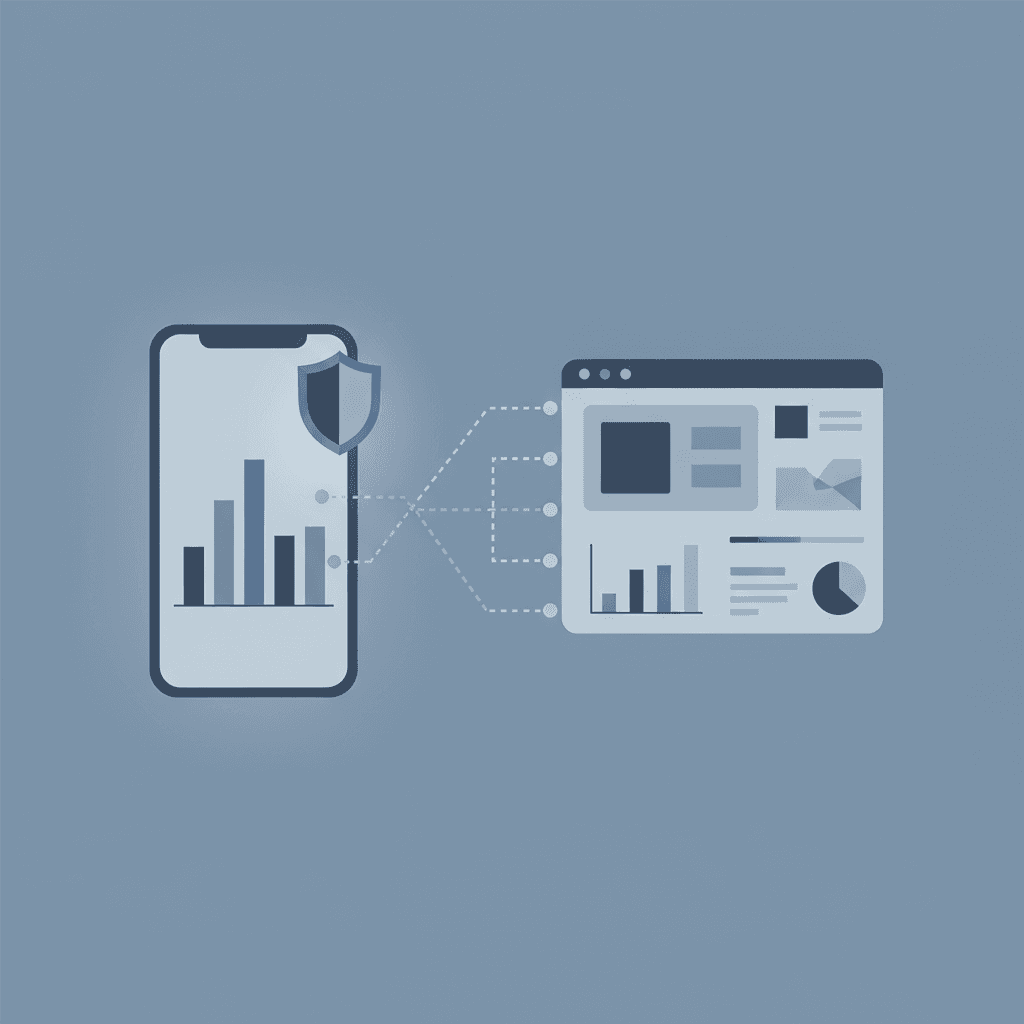
SKAdNetwork (SKAN) is Apple's framework for measuring iOS app install campaigns without exposing user-level data to ad networks. Rather than passing individual identifiers, SKAN sends aggregated, delayed postbacks to the ad network — signals that confirm an install occurred and, optionally, what happened afterward, without revealing who performed those actions.
When a user clicks an ad and installs an app, the device waits through a privacy timer before sending a postback to the ad network. That postback carries a campaign ID, a source app ID, and a conversion value — a number you define to represent an in-app event or revenue range. The postback is capped: only the winning ad network receives it, and the conversion value is limited by bit depth (6 bits in SKAN 3.0; expanded in SKAN 4.0). Meta receives this postback as aggregate signal, not tied to any individual iOS user.
SKAN 4.0, introduced in late 2022 and still being adopted through 2025, adds multiple postback windows for capturing downstream events, a coarse-grained conversion value for lower-privacy-threshold installs, and crowd anonymity thresholds that further filter what gets reported. This is meaningful for attribution-window planning, since first-window postbacks arrive within 24–48 hours but carry limited fidelity, while later windows can carry richer signal at longer latency.
For iOS app-install campaigns, Meta's optimization engine receives SKAN postbacks as its primary signal source — not pixel data, not user-level conversion API (CAPI) events. This changes how the learning phase behaves: fewer conversion signals, longer aggregation delays, and coarser event granularity than web campaigns. Multi-touch attribution models that depend on user-level identity cannot function on SKAN traffic; you're working with statistical inference at the campaign level.
In Advantage+ App Campaigns, Meta's Andromeda delivery system uses modeled conversions alongside SKAN postbacks to compensate for signal gaps — but the model requires volume to be reliable. Accounts running low install counts see higher noise in their SKAN-sourced CPA reads.
For context on how attribution more broadly works across iOS and web, and how to structure measurement when signal is degraded, the posts on Meta API integration software and AI for social media advertising both address how practitioners are patching the measurement gap.
Practitioner principle: treat SKAN CPA as a directional signal with a 24–48 hour floor, not a same-day decision metric.
For app-install advertisers on iOS, SKAdNetwork has replaced the rich user-level signal Meta used to optimize against. I've seen accounts misread SKAN CPA as equivalent to pixel CPA — they're not. Learning-phase exits and CPA reads behave differently when SKAN is the primary data source: the latency is longer, the granularity is lower, and the optimization event hierarchy needs deliberate schema design to surface any LTV signal at all.
