Creative volume is the number of distinct ad creatives you produce, run, and test. It is the input that lets you find winners and feed the algorithm at scale — more shots on goal, not more polish on one.

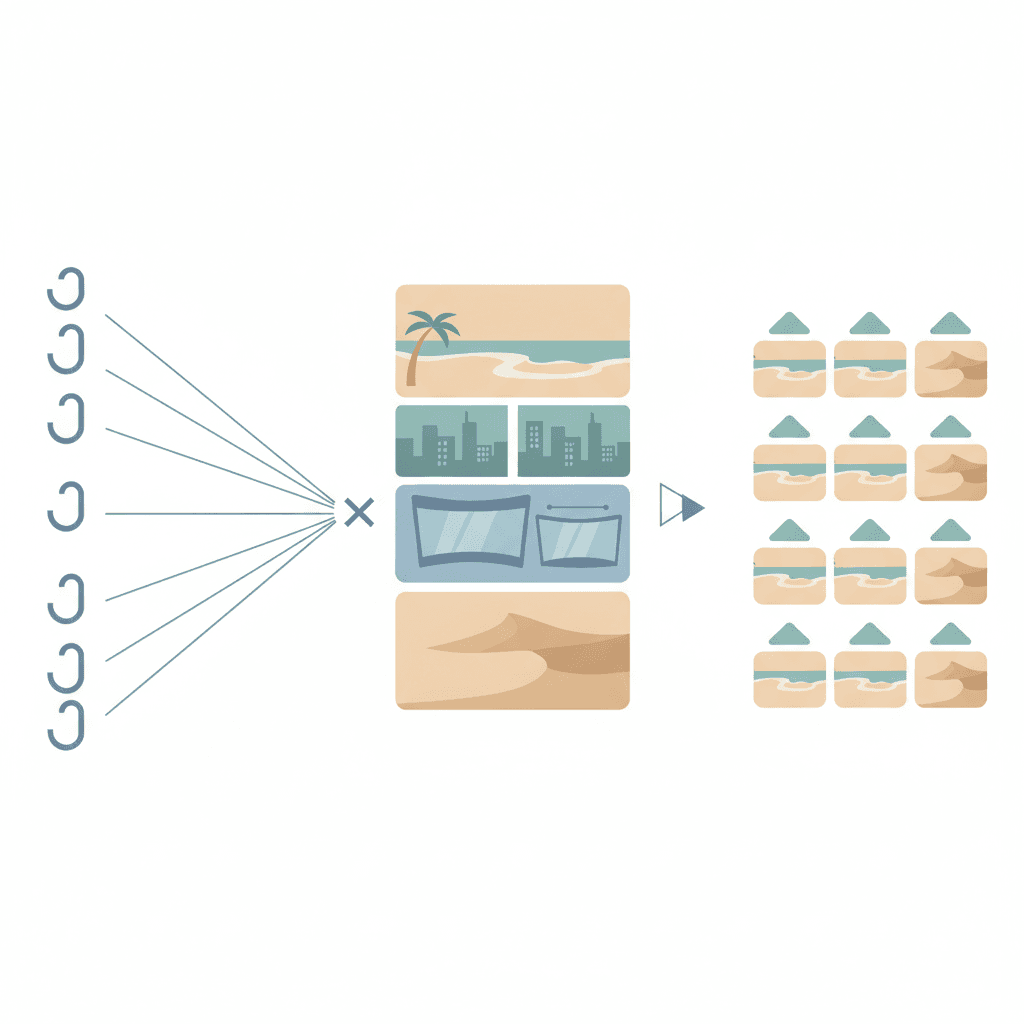
Creative volume is the number of distinct ad creatives you have in market and in your test pipeline at any given time. It is a supply metric, not a quality metric. Run four ads and your volume is four. Run four hundred and it is four hundred. The concept answers one blunt question: how many different swings are you taking?
At scale, volume beats polish. A single well-made ad has one hook, one angle, one audience match. The paid-media platforms reward breadth — Meta's own guidance on Advantage+ creative is built around producing and optimizing diverse ads in multiple formats, because the system needs many candidates to explore before it can exploit a winner, and audiences fatigue faster than most advertisers expect. So the job is less "make the perfect ad" and more "manufacture forty decent ones and let creative testing find the two that print." Volume is what makes that possible.
There are five production methods that turn a trickle of ads into a flood. First, AI-generated statics: a native static ad is trivial to mass-produce now — Meta's Advantage+ creative tools can generate image, video, and text variants directly — so there is little reason to run only a handful. Second, customer-sourced ads — every result screenshot, review, or before-and-after from your community is a usable ad. Two hundred customers per launch is two hundred ads on the low end. Third, an incentivized user-generated content engine: offer a small bonus to any customer who films themselves using the product, and every buyer becomes a creative supplier. That is a self-replenishing pipeline, not a one-time shoot.
Fourth, repurposing: clip existing live sessions, Q&As, and quick-tips into both organic posts and paid ads. Fifth, the multi-setting method — take your twenty highest-converting hooks, film each in four different settings, and you have eighty video ads from a single day of production. Stack these methods and the ceiling moves from four ads to eight hundred. For the full build, see the creative volume playbook and this high-volume creative strategy for Meta ads.
Volume is not the same as creative testing, and it is not creative refresh cadence. Volume is the raw count of creatives you can put in front of a test. Testing is the method that reads which of them win. Refresh cadence is the rhythm at which you replace tired ads with fresh ones. You need all three, but they are different levers. High volume with no testing system is just noise. A disciplined test with only four inputs starves for signal. Each ad should still carry a distinct creative angle — volume means many bets, not the same bet printed eighty times. To generate the inputs faster, most teams now lean on generative AI for ad creative and mine swipe files of proven competitor work to seed fresh directions.
Four ads is a weak spot, and it is the most common one. When an account runs only two images and two videos, there is nothing to rotate into when creative fatigue hits — and it always hits. The algorithm needs a deep bench to keep hook-rate and thumb-stop rates from collapsing as the same audiences see the same frames again and again. Volume is the supply that keeps the machine fed.
Volume also compounds performance in a measurable way. Nielsen's cross-platform work on what actually drives ad sales found that running at least two creative formats lifted sales performance by 1.6x — evidence that format and creative diversity, the direct output of volume, moves the number that matters. The mindset shift is treating volume as a supply-chain problem, not a design problem. Designers make one great ad. Supply chains make eighty adequate ones on a repeatable schedule. That reframing is what frees up spend. If you want to scale budget you first have to widen the audience by moving upfunnel through the levels of awareness, then keep spend cadence high with a constant stream of fresh creative. You cannot pour money into a launch you have only four ads to feed. Volume is the constraint that quietly caps everyone else's spend.
This is where competitive ad data earns its keep. When we look across in-market ads on adlibrary, the accounts spending the most are almost never running the most beautiful ads — they are running the most ads, cycling distinct hooks and formats faster than their rivals refresh. You can mine that pattern directly: use unified ad search to pull a competitor's full creative wall, save the winners into a working swipe file, and let AI ad enrichment tag the hooks and angles so you can seed your own volume from proven directions instead of a blank page. That is the fast path from four ads to a real pipeline — see the ad creative velocity breakdown, the ad creative testing workflow, the AI creative iteration loop, and the 7-step guide to automating ad creative for ecommerce.
