Your AI creative iteration loop is generating 100 variants a week and your winning ad rate is identical to six months ago. The problem is not the volume — it is the absence of a closed feedback loop. I've shipped this loop across a dozen accounts: the teams that compound results are the ones treating each generation cycle as a learning cycle. This use case gives you the four-stage system that turns in-market signal into better prompts, week over week.
Creative strategists, performance creative producers, and growth-engineering teams using AI tools such as Midjourney, Runway, Veo, and Claude to generate paid-social variants. If you want a structured loop from angle research through in-market test to prompt improvement — rather than one-off batch generations — this workflow is built for you.
AI tools have collapsed ad creative production cost from $300 per asset to under $5. The new bottleneck is judgment — which generations are worth testing, which iterations are real improvements vs. noise, and how to use in-market signal to train the next AI creative iteration loop cycle.
Most teams using AI for paid-social creative produce 100x more variants. Their winning ad testing rate is unchanged. The reason is structural: they have no closed loop between what performed in-market and what goes into the next prompt template. Volume without a feedback mechanism is just faster noise generation. The four layers of AI in ad platforms make this worse — each layer automates a step without connecting it to the others. The assets stack up; the creative strategy does not improve.
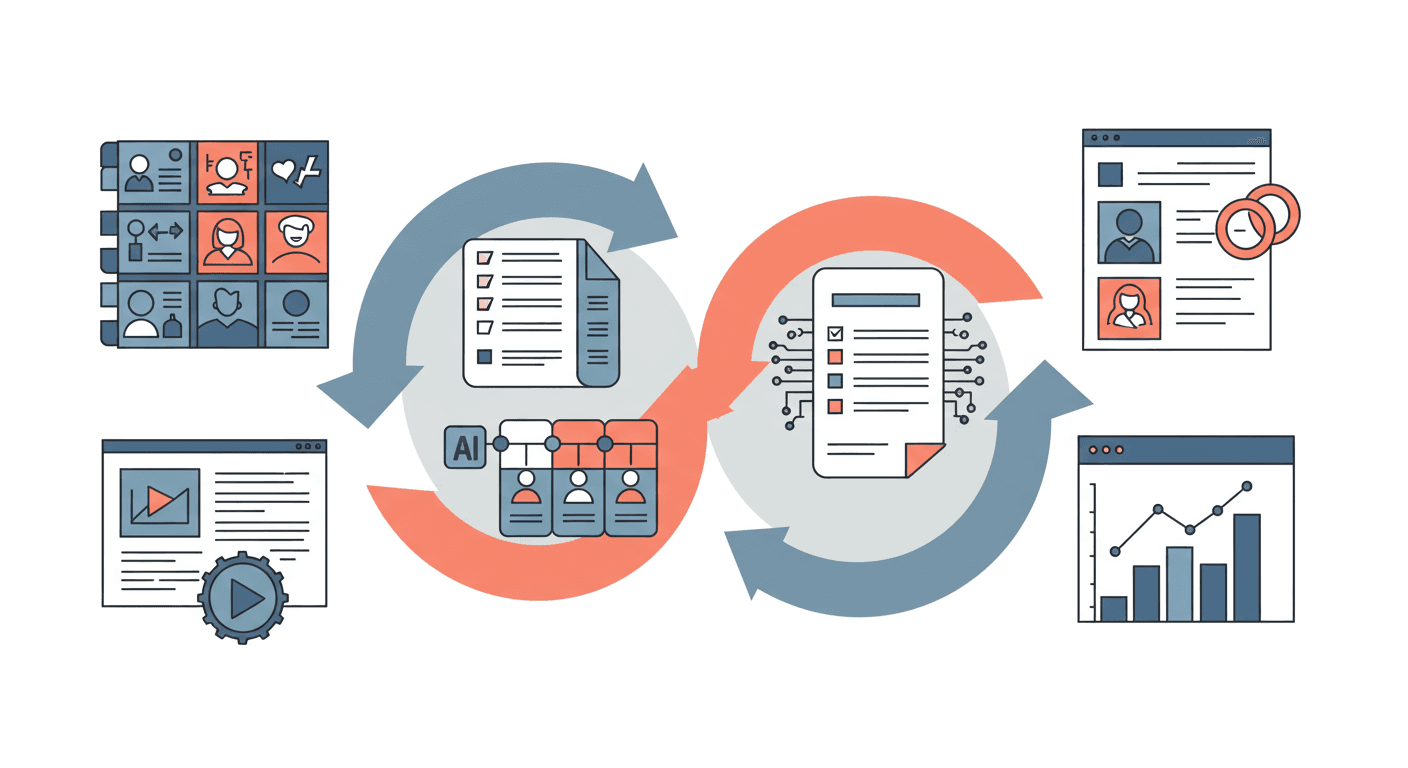
The AI creative iteration loop is a four-stage system that runs weekly and compounds with each cycle. Most teams using AI for paid-social are stuck in a generation loop with no feedback mechanism — the evidence is consistent: volume goes up, winning-ad-rate stays flat.
Stage one: competitor angle research — pull 50+ ads from your category using unified ad search, group by angle type (problem-led, product-led, lifestyle, social-proof, contrarian), and tag each with engagement signals. You come out with 5–8 angles that have empirical backing. This is what separates a structured AI creative iteration loop from random batch generation.
Stage two: build a prompt template that encodes brand voice, audience ICP, a banlist of clichés, and the chosen angle. The tool choice matters less than the template — a well-structured prompt on a mid-tier model outperforms a generic prompt on the best model.
Stage three: generate 4–6 variants per angle, review for voice match, then launch all into a single ad set with dynamic creative optimization. Use hook rate as the primary kill metric; CPA as secondary. For a benchmarked view of what high-volume creative teams actually ship, see high-volume creative strategy.
Stage four — the one most teams skip — is the retrospective. Decompose winning variants into feature flags: hook style, frame composition, copy structure. Feed those flags back into the next prompt template. Each cycle of the AI creative iteration loop improves the template; each improved template raises the floor on the next generation. Teams that skip the retrospective regenerate the same average output indefinitely.
A creative team that ships 30–80 fresh ad variants per week at under $200 total production cost, with winning-ad-rate climbing 8–15% per iteration cycle as the prompt template improves. Time from idea to in-market test drops from 14 days to 36 hours. See how teams use ad timeline analysis to track competitor creative refresh cadence and calibrate their own cycle timing. The compounding effect is real — but only if the retrospective step runs every cycle without exception.
