A Creative Angle is the unique entry point an ad takes into a category — the specific belief, frustration, or desire it targets, distinct from the product or the offer.
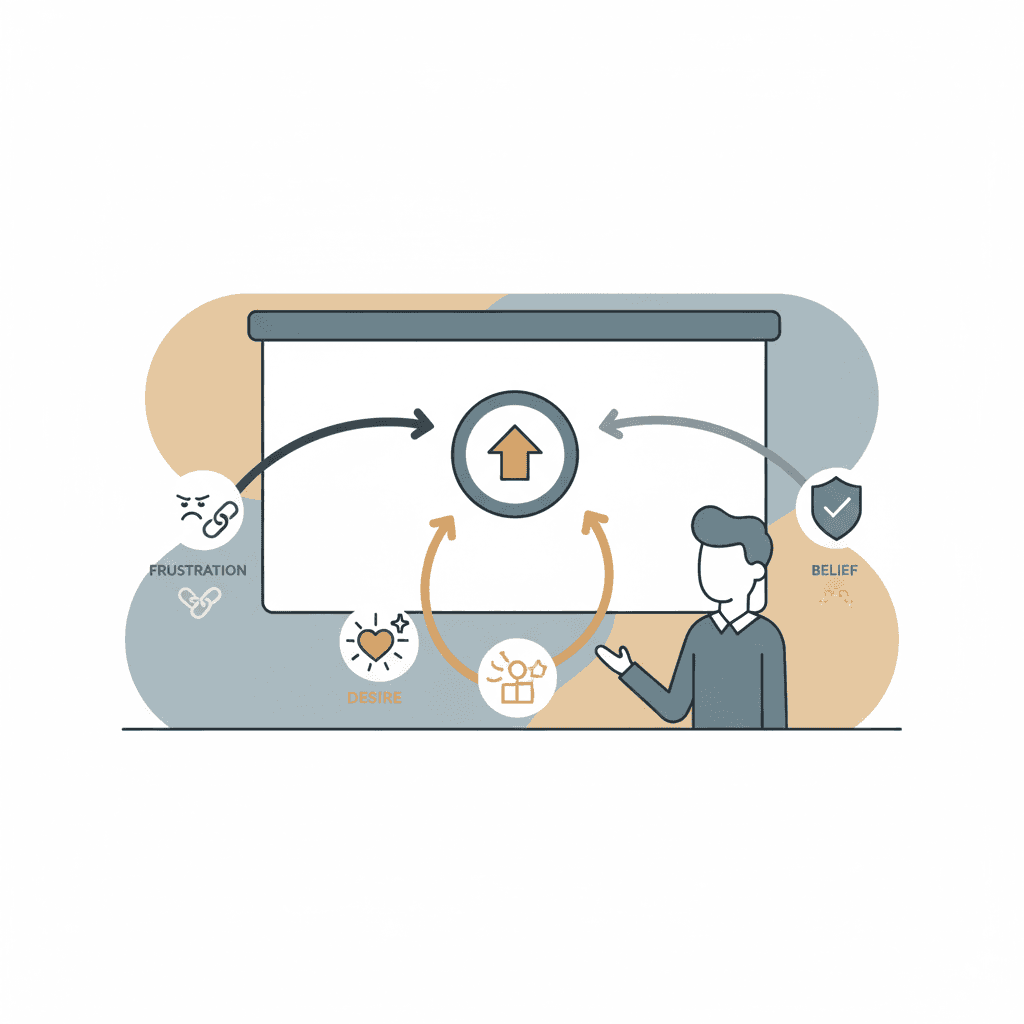
A creative angle is the specific entry point an ad takes into a category. Not the product. Not the offer. The particular belief, frustration, or desire the ad speaks to — the psychological doorway it opens before asking for anything.
The mechanism works like this: every category has a pool of audience beliefs your ad can address. A fitness supplement could speak to the person who is tired of being tired, to the parent who lost their pre-kids fitness identity, or to the athlete who plateaus despite doing everything right. These are distinct angles. Same product, same offer — completely different emotional entry points. Each angle activates a different segment of your cold traffic and produces a different creative response.
Angle selection operates upstream of every creative decision you make. Hook format, visual style, and copy tone all sit downstream — they're how you execute the angle, not the angle itself. I've reviewed accounts where a team spent six figures on creative production and tested 40 variants, then concluded the product "doesn't convert." In most cases, they tested 40 executions of the same saturated angle. The production was fine. The direction was exhausted.
In Meta's current delivery environment — Advantage+ audiences, Andromeda's ML-driven distribution, and compressed signal feedback loops — angle diversity matters more than it did when manual targeting did the segmentation work. The algorithm can find your audience across placements, but it can only distribute what you give it. Diverse angles let the system find multiple distinct buyer segments rather than optimizing toward the same narrow slice.
Use the Meta Ad Library and tools like AdLibrary's ad timeline analysis to identify which angles competitors have been running for 30+ days — longevity signals that an angle is working. Use that as a map of what's been claimed, not a script to copy.
For a deeper look at how angle connects to creative strategy and hook construction, the AI for social media advertising guide covers how practitioners are using data to surface untapped angles at scale. The high-volume creative strategy guide shows how to operationalize angle diversity across a large ad program without losing direction.
The practitioner principle: angle is direction, and direction determines where you arrive.
Angle is the highest-leverage variable in paid media. Production quality, hook style, and offer structure all multiply against angle — but no amount of polish rescues a saturated angle. When a category has seen the same entry point across fifty ads, the brain stops processing it as signal.
I find that the accounts with the best creative output aren't necessarily producing the most content — they're producing from more directions. They've built a creative research process that surfaces audience beliefs the category hasn't claimed yet, then they test angles before they test executions. That ordering is what separates scalable creative systems from accounts stuck in a production loop.
