Media arbitrage is buying clicks and attention for less than you earn from them, which makes paid traffic profit-positive and turns scaling ad spend into an arithmetic decision rather than a leap of faith.

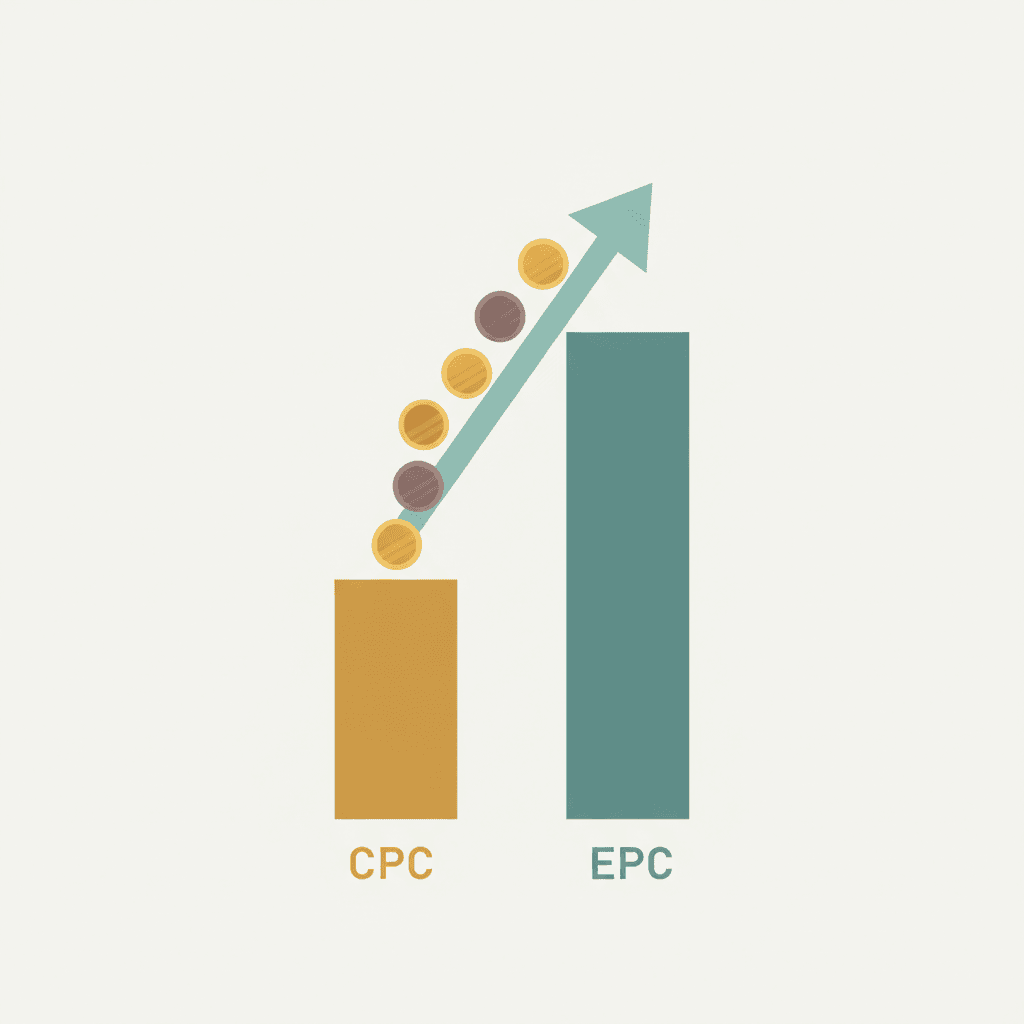
Media arbitrage is buying clicks and attention for less than you earn from the traffic they send you. When the money a visitor generates outruns the money you paid to reach them, paid traffic stops being a cost line and becomes a spread you can widen on purpose. That spread is the whole game. Frame the business right and every extra dollar of ad spend buys you more than a dollar back.
The core equation is earnings per click against cost per click, written EPC > CPC. EPC is the revenue a click is worth downstream. CPC is what you paid the platform for it in the ad auction. If a click earns $2.10 and costs $0.80, you are turning eighty-cent inputs into $2.10 outputs. That is not a metaphor. In finance, arbitrage means profiting from a price gap that should not exist, and paid media gives you exactly that: you are buying dollars at a discount, and the only rational response to a discount on dollars is to buy more of them.
This reframes the whole cost conversation. Most advertisers treat ad spend as a number to minimize and quietly cap return on ad spend at a comfortable threshold. But a profitable arbitrage inverts that logic: the spend is not the cost, it is the purchase. Once you know your lifetime value and your customer acquisition cost, the ceiling on spend is set by supply, not by fear. You can size the room with a break-even ROAS calculator and an LTV calculator before you ever touch the budget slider.
If the math holds, only three things actually limit how far you can push it. First, creative supply: you cannot spend into audiences with four ads, because fatigue closes the click-through rate long before you run out of budget. Second, audience supply: a narrow offer-aware pool drains fast, so scaling means moving upfunnel through the levels of awareness toward larger problem-aware audiences. Third, knowing your true unit economics: LTV, CAC, and average order value. Miss any of the three and the arbitrage looks broken when it is really just starved. Get all three right and scaling becomes an arithmetic problem, not a nerve problem.
Spend also is not poured evenly across a window. A launch has a rhythm you can read in the spend cadence. Test creative early, scale into the middle, and press hardest when deadline urgency peaks. The arbitrage is the reason the cadence is worth running at all.
Media arbitrage matters because it settles the single hardest decision in paid media: how much to spend. Most advertisers answer it with a feeling, not a number. They watch cost per acquisition tick up, get nervous, and cap the budget well below what the economics would allow. We have watched accounts leave months of profit on the table for no reason other than the spend number looking scary. The fear is a mental-accounting error, treating ad spend as an expense to survive rather than an investment that clears at a profit.
Here is the mindset shift. If EPC beats CPC after lifetime value is counted, spending more is not a risk, it is a decision to buy more discounted dollars. Optimizing toward value-based bidding instead of raw conversions is how you make the platform chase that downstream value on your behalf. Loss aversion makes an advertiser feel a $50,000 spend line as $50,000 at risk, when a proven arbitrage means it is a $50,000 order for $70,000 of margin. Reframe the number and the reason you cap your ad spend mostly evaporates. Scaling stops being a leap of faith and becomes the obvious next move, which is why practitioners talk about scaling ad spend confidently rather than cautiously.
The discipline that makes the reframe safe is your break-even ROAS. Break-even is the line where a click stops paying for itself. As long as your true, LTV-adjusted return sits above it, the arbitrage is open and more spend is more profit. Confirm the line with a ROAS calculator and a CPA calculator, then decide how the budget flows across a launch using a spend-scaling roadmap. The point of measuring is not to shrink spend. It is to prove the arbitrage so you can grow it without flinching, and to know exactly how much to spend on ads per launch.
Keeping the arbitrage open is mostly a creative problem, and that is where the data layer earns its place. An arbitrage closes when the winning creative fatigues and nothing replaces it. Watching which hooks and angles are actually pulling across in-market ads with unified ad search shortens the hunt for the next winner, which keeps the spread wide while you scale. Find the creative that holds CPC down, and the arbitrage stays profitable at a size that would have felt reckless a launch ago.
