Earnings per click (EPC) is the total revenue attributable to a traffic source divided by the total clicks it delivered — in short, revenue ÷ clicks.
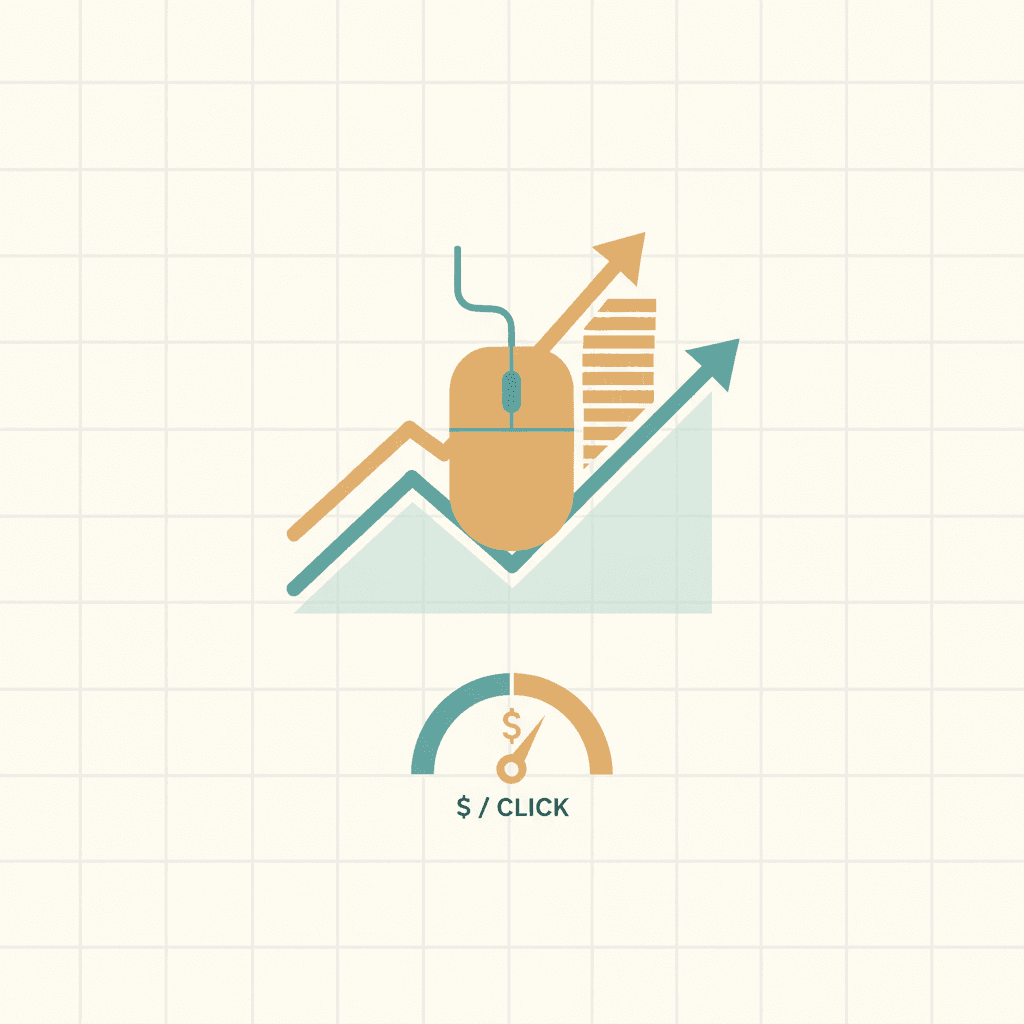
Earnings per click (EPC) is the revenue a traffic source generates divided by the number of clicks it sends you. Write it as a plain ratio: EPC = total attributable revenue ÷ total clicks. If a Meta campaign drove 2,000 clicks and $4,000 in tracked revenue, its EPC is $2.00. Every click, on average, was worth two dollars to the business.
Two conventions exist, and mixing them up is the fastest way to misread a report. Performance marketers usually express EPC as revenue per single click ($2.00 above). Affiliate and media-buying networks often quote EPC as revenue per 100 clicks — the same campaign would show an EPC of $200. The math is identical. Only the denominator moves. Always confirm which base a number uses before you compare two sources.
A worked example. Say a launch sends 5,000 clicks from a Facebook campaign to a landing page. Downstream, those clicks produce 150 purchases at a $36 average order value, so $5,400 in front-end revenue. EPC = $5,400 ÷ 5,000 = $1.08 per click. Now bring in cost. If your cost per click (CPC) on that campaign is $0.70, you are buying clicks for 70 cents and earning $1.08 from each — a positive spread on every click. Track CPC with the CPC calculator and model the revenue side with the conversion rate calculator.
EPC and CPC are the two halves of the same trade. CPC is what you pay for a click; EPC is what that click pays you back. When EPC exceeds CPC, the gap is your margin per click, and every additional click you can buy is profit-positive. This spread is the whole basis of media arbitrage — buying attention for less than it returns. It also reframes click-through rate (CTR): a higher CTR lowers your effective CPC, which widens the EPC-to-CPC spread even when revenue per click holds flat. Our guide to CTR in 2026 covers how that lever moves cost.
EPC is only trustworthy when the revenue in the numerator is real revenue, not proxy events. The practical method: optimize your Meta campaign for the purchase event rather than clicks or leads, let it exit the learning phase on stable purchase signal, then divide the tracked downstream revenue by the clicks the campaign delivered. Because signal loss makes some conversions invisible, lean on the Conversions API (CAPI) for server-side accuracy and read modeled conversions and Meta's conversion modeling so your EPC is not understated by attribution gaps. Meta documents this optimization path in its Ads Manager help on conversion optimization, and Google frames the same idea as value-based bidding in its Google Ads conversion-value docs. For downstream affiliate revenue, the CJ Affiliate network popularized the per-100-clicks EPC convention that many media buyers still quote.
One more refinement: choose your attribution window deliberately. A 7-day-click EPC and a 1-day-click EPC describe the same campaign but credit revenue differently, and a learning-limited ad set will report a noisy, unreliable EPC until it accumulates enough conversions to stabilize.
EPC matters because it removes the fear that makes advertisers cap their own spend. Most media buyers stop scaling not because the math turned negative but because they cannot see the math at all. If you know EPC is greater than CPC, every extra click you buy is profit — so there is no reason to stop buying clicks. That single number converts a nervous gut decision into an arithmetic one.
This is the mindset shift behind media arbitrage: a business that reliably earns more per click than it pays is buying dollars at a discount, and the only real constraints become creative supply and audience supply — not budget nerve. When advertisers self-cap at a low cost-per-click ceiling for no good reason, they leave the entire positive-spread zone unspent. Measuring EPC exposes exactly how much room is left, which is why the fear of scaling and the question of how much to spend per launch both dissolve once you manage off EPC instead of guesswork.
EPC also protects you from the opposite error — scaling a click-cheap campaign that never monetizes. Pair it with ROAS and your breakeven ROAS so you know the exact EPC floor at which spend turns unprofitable. Below that floor, more clicks lose money faster. Above it, holding budget back is the mistake. The reasons advertisers cap ad spend almost always trace to never having computed this floor.
This is where an ad-intelligence data layer earns its place. When we look across in-market ads on adlibrary's unified ad search, the advertisers running dozens of creatives against the same offer are the ones with EPC headroom to exploit — they can afford volume because their per-click economics support it. Study how those brands rotate hooks with ad timeline analysis, enrich each creative's angle and format with AI ad enrichment, and pull the raw data programmatically through the ad-intelligence API to benchmark your own EPC against the field. adlibrary indexes ads across multiple platforms, so the EPC comparison is not Meta-only. Benchmarks like our 2026 ecommerce Meta ad benchmarks and our breakdown of cost-per-click give you the reference points to judge whether your EPC spread is wide or thin. For the full scaling motion, the guide to scaling ecommerce revenue and the Facebook budget-allocation guide both hinge on this same per-click confidence.
