A Post-Purchase Survey is a one-question prompt shown after checkout asking customers how they heard about the brand — used as the cheapest, fastest ground-truth check against pixel-attributed source.
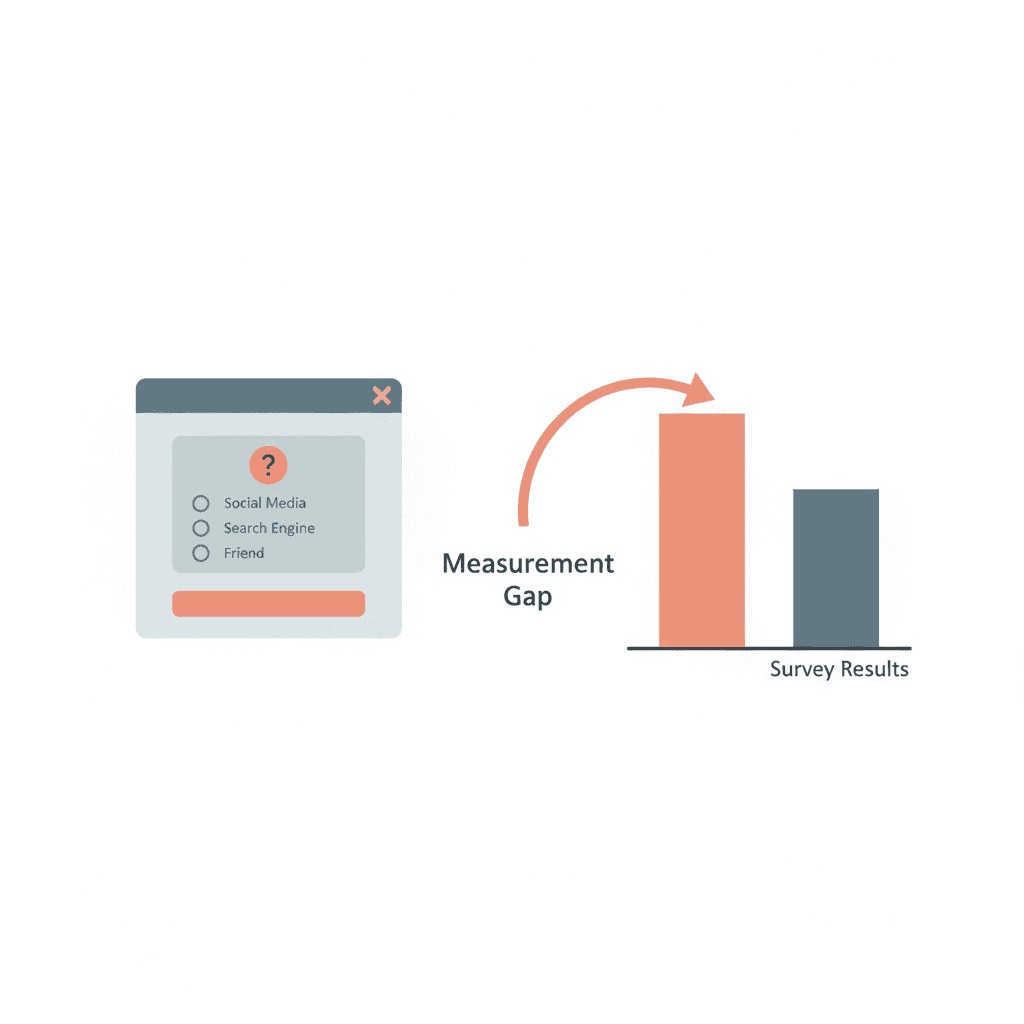
Post-purchase surveys are a one-question prompt shown on the order confirmation page asking customers how they heard about you. The mechanism is direct: the customer self-reports the channel that drove their purchase, giving you ground-truth signal that pixel-based systems cannot produce.
How it works in practice: you set a survey tool (KnoCommerce and Fairing are the two most common in DTC), drop it on the Shopify order confirmation page, and route responses into a dashboard that maps self-reported attribution against your ad platform numbers. The math is simple — if Meta claims 60% of revenue but surveyed customers say 42%, you have an 18-point gap. That gap is a direct measure of iOS-14 signal loss, cookie deprecation, and branded-search cannibalization.
We treat that gap as a measurement tax. Every brand running paid social is paying it; most just can't see it. The survey makes the tax visible.
In the current paid-media environment, post-purchase surveys have become a first-line tool alongside incrementality testing and MMM. With Advantage+ compressing campaign-level reporting and Andromeda blurring creative performance attribution, pixel data alone understates top-of-funnel and influencer channels systematically. The survey is the one measurement that doesn't route through a platform's reporting layer — it asks the customer directly.
That also makes it the fastest check against platform attribution inflation. You don't need a 6-week holdout or a Meridian/Robyn run to catch a 15-point gap. You check the survey weekly.
The limitation is real: response rates on single-question surveys run 40–55%, which means roughly half your customers don't answer. Use survey data as directional signal, not a hard number. Stack it against your modeled-conversions and platform data to triangulate, not to overrule. The two source articles that informed this definition go deeper on the mechanics: why pixel attribution is structurally broken in 2026 and which AI analytics tools handle the gap best.
One rule: run the survey continuously, not once. A single data point tells you the current gap. The time series tells you when your measurement is drifting — which is the only signal that matters after a platform algorithm update.
Pixel attribution says Meta drove 60% of revenue; post-purchase survey says it was 42%. The 18-point gap is the iOS-14 / cookie-deprecation / branded-search-cannibalization tax — and you cannot see it without asking the customer directly. Every paid-media decision made without that ground-truth check is building on a number the platform generated about itself. I've seen brands cut influencer spend by 40% based on pixel data, then discover post-purchase survey was the only measurement consistently crediting those placements. The survey costs under an hour to set up. The cost of not having it is structural misallocation.
