Incrementality is the share of conversions or revenue that would not have happened without the ad — the true causal effect of advertising, isolated from organic, search, retargeting cannibalization, and seasonal demand.
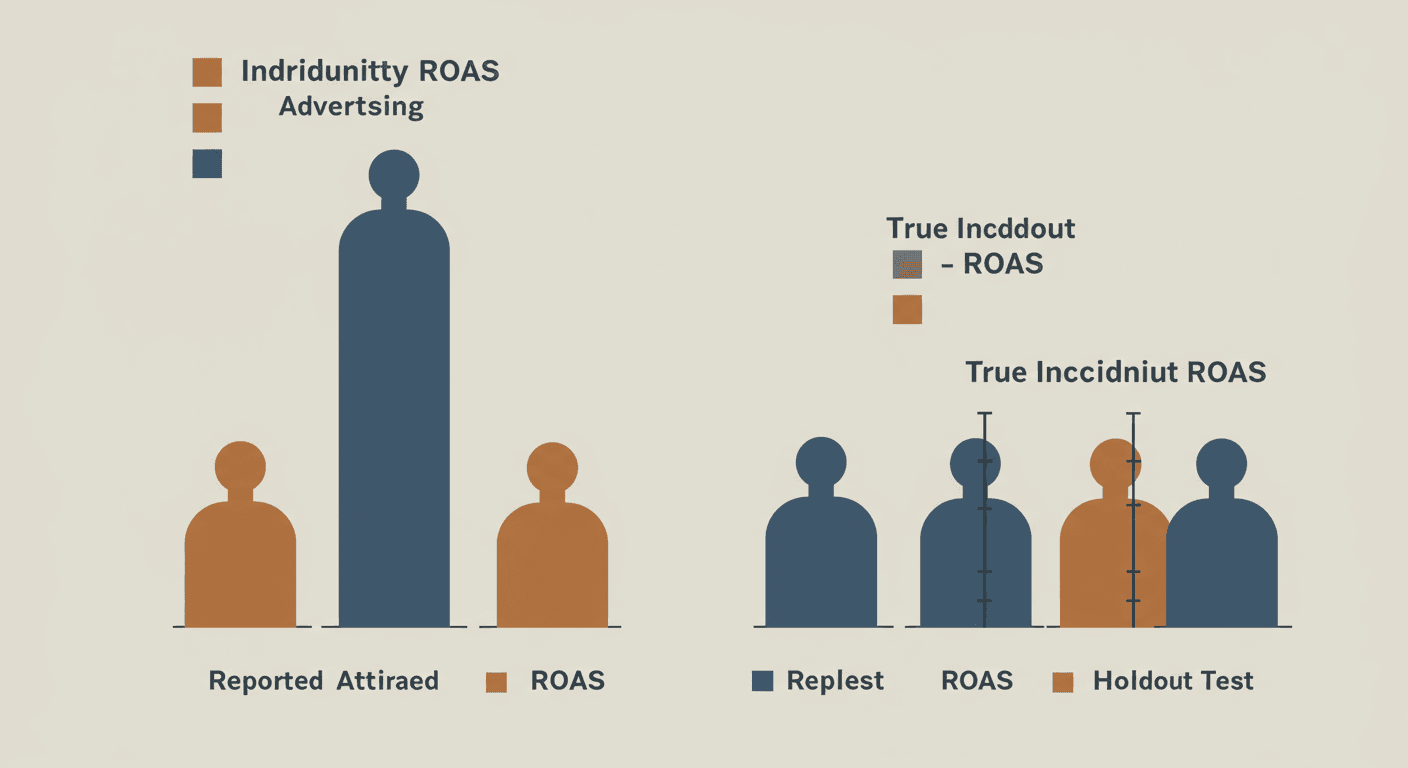
Incrementality measures the conversions or revenue your ads actually caused — the results that would not have occurred if the ad had never run. Not the conversions your attribution model credits. The ones that required the ad to exist.
The mechanism is a controlled experiment. You split your eligible audience into two groups: an exposed group that sees the ad and a randomized holdout that does not. After a defined window, you compare conversion rates. The gap between exposed and holdout is the incremental lift. Divide incremental revenue by spend, and you have incremental ROAS — a number that tells you whether the ad generated new demand or just intercepted demand that was already on its way.
Why does this differ so sharply from reported ROAS? Because last-click and most multi-touch attribution models assign credit to whatever ad touched the journey last, regardless of whether it caused anything. Retargeting ads fire on users who were already deep in the funnel. Branded search captures users who typed your brand name because they already intended to buy. Both report strong ROAS; neither is generating incrementality. In accounts we've audited, reported ROAS on branded search often runs 4–5x while incremental ROAS is below 1x.
The 2025–2026 measurement environment makes this worse before it makes it better. iOS signal loss forces Meta and Google to model conversions — those modeled numbers flow into attribution dashboards and inflate the already-inflated figures. Meanwhile, Advantage+ campaigns and Google's Meridian/Robyn MMM frameworks are pushing advertisers toward geo-holdout and media mix approaches specifically because traditional attribution can't separate cause from coincidence.
For practical measurement, three methods work: Meta and Google's built-in conversion lift studies (randomized holdouts within the platform), matched-market geo-split tests paired with media mix modeling, and third-party incrementality platforms that orchestrate multi-channel holdouts simultaneously. Each has tradeoffs in turnaround time, granularity, and cost — explored in depth in why attribution is failing in 2026 and the AI analytics tools doing the math.
Treat incremental ROAS as the only ROAS that matters for budget allocation decisions.
Most accounts run with reported ROAS that is 1.5–2x higher than true incremental ROAS. Decisions made on the inflated number scale spend into channels that look profitable but are adding nothing on top of organic. We've watched teams defend retargeting budgets at 4x ROAS for years while the incremental number sat below 1x. Incrementality is the unreported financial truth — and the number your channel budget should be built on.
