Media Mix Modeling is a statistical regression method that estimates each marketing channel's contribution to revenue using historical spend, impression, and outcome data — independent of pixels, cookies, or user-level tracking.
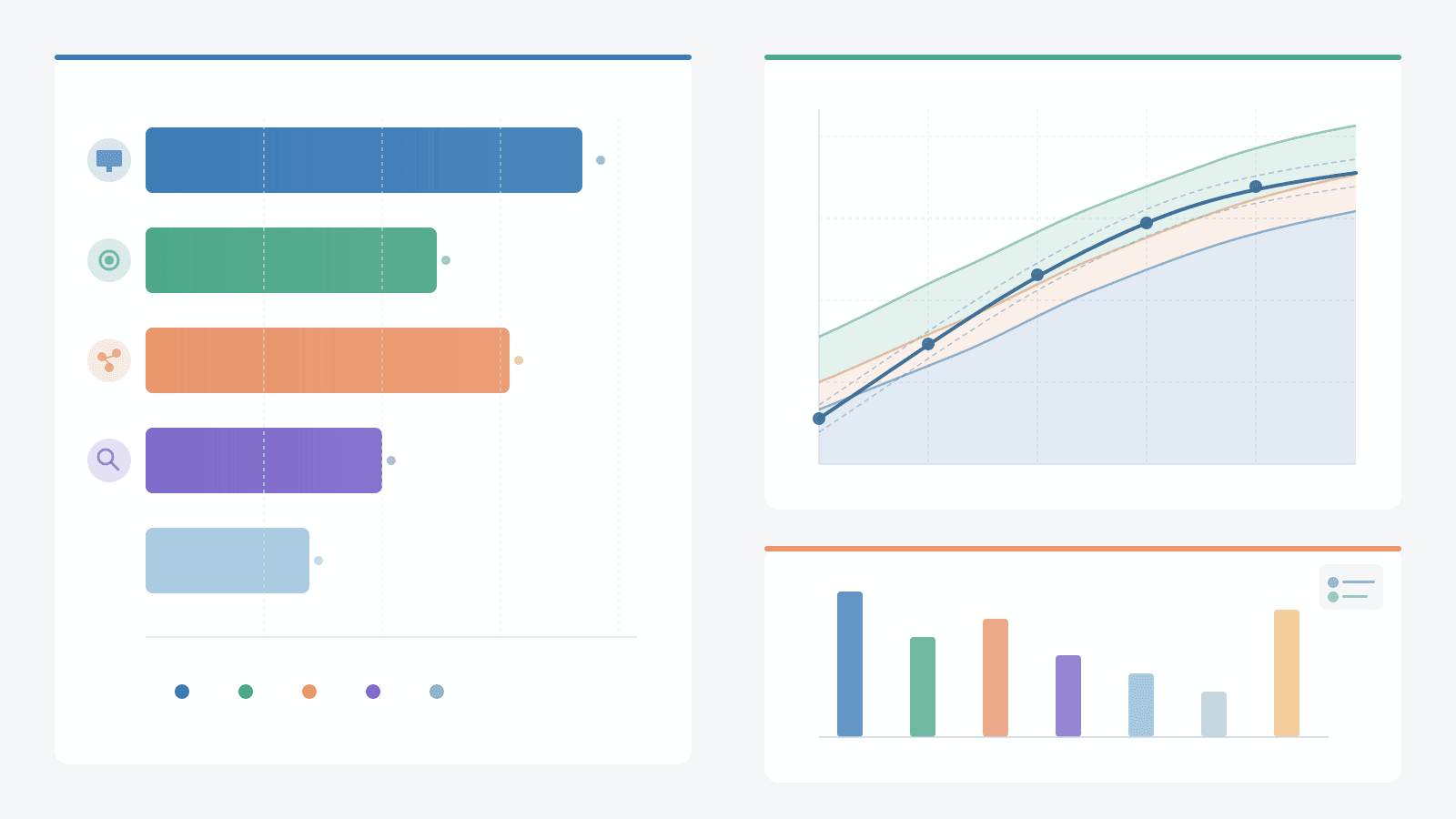
Media Mix Modeling (MMM) is a regression-based statistical method that quantifies each marketing channel's contribution to business outcomes — revenue, conversions, or volume — using aggregated historical data on spend, impressions, and results. No pixels. No cookies. No individual identity required.
The mechanism is straightforward: you feed the model weekly (or daily) time-series data for every channel — TV GRPs, paid social spend, search impressions, OOH, email sends — alongside a dependent variable like revenue. The regression algorithm estimates a coefficient for each channel: how much a marginal dollar of spend in that channel generates in output, holding all others constant. Adstock and saturation curves account for the fact that advertising effects decay over time and diminish at high spend levels. What you get out is a decomposition: of your last 18 months of revenue, what percentage came from each channel versus baseline (organic demand).
The practical execution has moved fast. Google's open-source Meridian and Meta's Robyn framework, along with PyMC-Marketing's Bayesian extension, have brought MMM within reach of in-house analytics teams. Bayesian MMM is especially useful for sparse data — you can encode prior beliefs about channel effectiveness from conversion lift results, which addresses one of the method's historical weaknesses. That combination of top-down MMM with calibration from conversion lift tests is now the recommended approach for most measurement stacks.
For practitioners running paid social in 2025–2026, MMM's relevance is inseparable from the post-iOS 14 collapse of multi-touch attribution. MTA depends on user-level tracking that simply no longer works at the accuracy it once had. MMM never needed it. The 2026 death of attribution measurement cycle is, in a real sense, a return to a method that was always more rigorous — just slower and more expensive to run. Platforms like Meta's Advantage+ and Andromeda have made channel-level signal even murkier, which makes the aggregate-level view of MMM more valuable, not less. For a broader look at where AI is reshaping how these models are built and interpreted, AI analytics tools for marketing in 2026 covers the current toolchain.
MMM answers the budget allocation question at the portfolio level. Build the model, re-fit it quarterly, and let the coefficients tell you where marginal spend actually works.
MMM is the only attribution method that survived iOS 14, GDPR, and cookie deprecation untouched — because it never needed user-level identity. When we look at how most brands rebuilt their measurement stacks after 2021, they land at MMM as the new ground truth, and rediscover it as the answer to questions the industry has been asking since the 1990s. It is slow, it requires data discipline, and it rewards patience. That is exactly why it works.
