Brand Lift is a randomized-control-trial measurement of whether ad exposure changed brand perception — awareness, ad recall, consideration, favorability — measured through survey responses from exposed vs. holdout users.
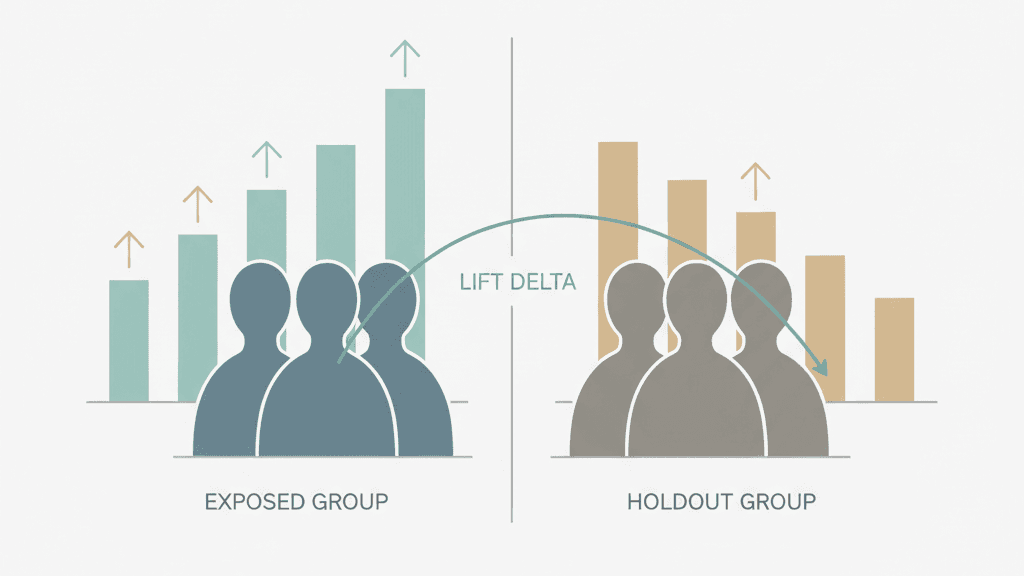
Brand lift is the measurable shift in brand perception (awareness, ad recall, consideration, favorability) caused by ad exposure. The mechanism is a randomized controlled trial: the platform splits eligible users into an exposed group (who see the ads) and a holdout group (who don't). Post-flight surveys collect responses from both groups. The delta between them is the lift.
That holdout methodology matters. Without a control group, you cannot separate brand perception gains driven by the ads from background shifts driven by PR, seasonality, or organic growth. The reach you buy only creates measurable value if the exposed group's survey responses actually diverge from the holdout — and that divergence is what brand lift quantifies.
The signal is also exposure-weighted. In practice, I've seen brand lift studies where 70%+ of the total awareness lift is concentrated in users who saw the ad three to five times. This connects directly to frequency strategy: if the holdout group is clean but the exposed group saw the ad once at a high CPM, lift will be weak regardless of creative quality. Platforms like Meta, YouTube, and LinkedIn each offer native brand lift study tools, and third-party vendors like Kantar, Nielsen, and Lucid provide cross-channel measurement.
The 2025–2026 paid media context adds complexity. iOS signal degradation means that conversion-event data is modeled for a significant share of users; brand lift surveys sidestep that problem because they collect direct survey responses rather than inferred behavior. As MMM tools like Meridian and Robyn gain adoption, brand lift data is increasingly used to calibrate the long-cycle contribution coefficients in those models — bridging the gap between weekly marketing mix outputs and upper-funnel campaign decisions.
Brand lift studies also surface creative-quality signals that performance metrics miss. A campaign objective optimized for clicks tells you nothing about whether the ad changed how someone thinks about your brand. For campaigns targeting cold traffic at the top of the funnel, lift studies on brand awareness and ad recall are often the only measurement tool that gives you an honest answer about whether the flight was working. See AI for Facebook Ads: Targeting, Creative, and Optimization in 2026 and Top LLMs for Marketing Teams 2026 for how creative systems and AI tooling intersect with brand measurement in current campaign workflows.
Run brand lift as a precondition for upper-funnel investment decisions, not an afterthought.
Performance teams measure clicks and purchases; brand teams measure awareness and recall. Brand lift is how those numbers connect — it tells you whether your reach buys actually moved the perception metrics that drive long-cycle demand. When we work with accounts that have been scaling spend without conversion lift explanations, brand lift studies frequently surface the answer: the reach was real, but the creative wasn't landing at the perception level. That's a fixable problem, but only if you measured it.
