A Retention Curve is the time-series shape of how new customers continue purchasing or engaging after acquisition — the leading indicator of whether the LTV side of LTV:CAC math actually holds.
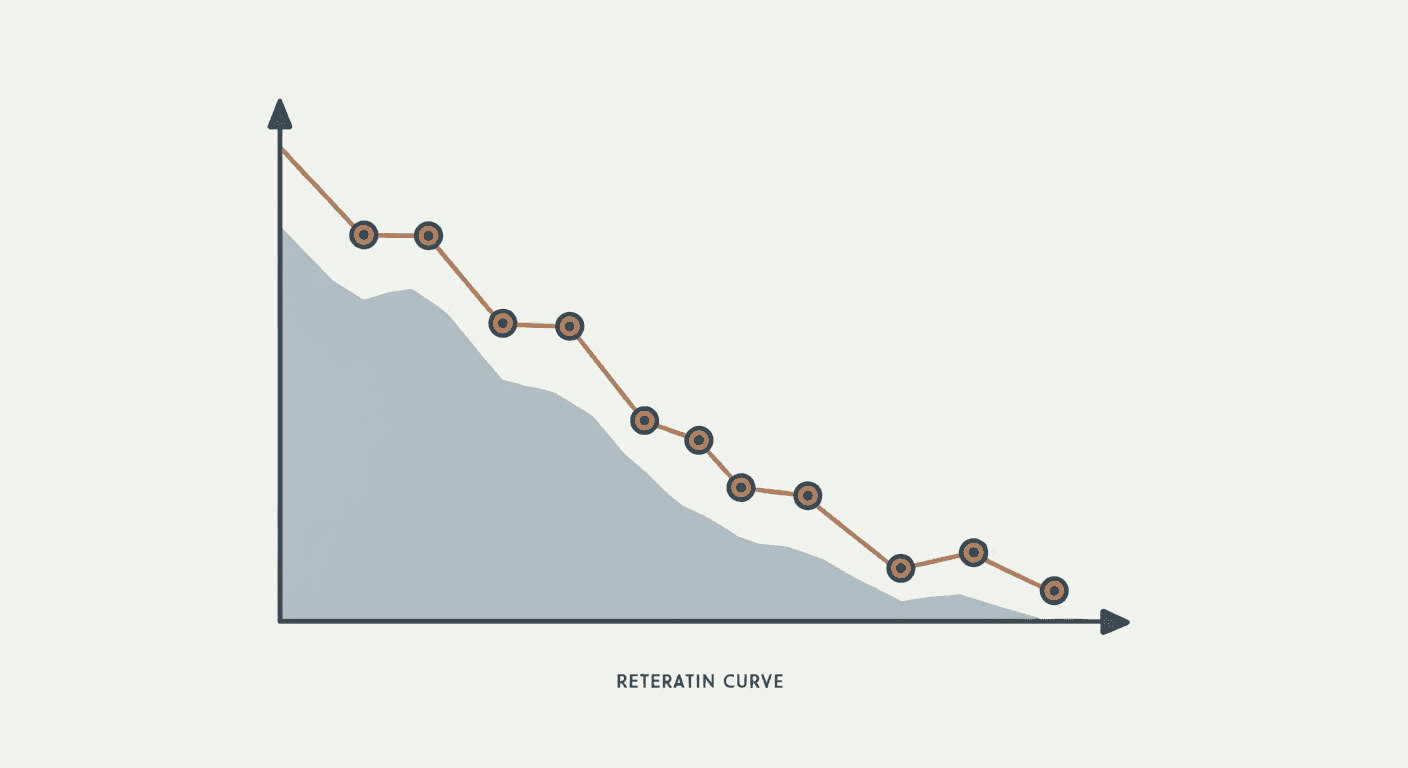
A retention curve is the shape that emerges when you plot what percentage of a customer cohort is still active — purchasing, logging in, subscribing — at each month after acquisition. It is not a single number. It is a line, and the slope and asymptote of that line determine whether your business actually makes money from the customers you paid to acquire.
The mechanism is straightforward: take a cohort of customers acquired in the same week, then track what fraction is still active at month 1, month 2, month 6, month 12. Plot those percentages and you have your curve. For most consumer businesses, the shape is log-shaped — a sharp early drop-off as low-intent buyers churn, followed by a flattening that represents the genuinely loyal segment. That flat section is your asymptote, and it is the number that actually matters for lifetime value (LTV) forecasting. Without it, any LTV projection is speculation.
We track retention curves across paid acquisition cohorts in adlibrary, and one pattern shows up consistently: accounts that optimize for acquisition CPA without watching the curve often scale a leaking bucket. The cohort looks fine at month 1 — then the curve keeps dropping past month 4 with no asymptote in sight. That is not a retention curve problem; it is a product-market fit or acquisition-channel mix problem showing up in the data first. The curve is the early warning system, not the diagnosis.
The 2025–2026 paid media context makes this more urgent. Advantage+ campaigns and Andromeda's delivery architecture optimize for conversion volume, not cohort quality. You can scale spend and hit your CPA target while acquiring cohorts that churn at month 2 and never stabilize. Meridian and Robyn MMM models do account for long-run revenue, but they need multiple mature cohorts to estimate retention decay accurately — which means you need clean cohort analysis data long before your MMM gives you reliable signals. Buying that data by running controlled acquisition experiments and reading the curves is the practitioner's job.
For a deeper look at how to build the measurement infrastructure that makes cohort tracking reliable, marketing tool stack for startups covers the stack choices that matter. For understanding how incrementality testing interacts with retention measurement — how channel-attributed retention misleads when some of that retention would have happened anyway — see marketing agency tool stack 2026.
Read the curve before you scale the campaign.
Acquisition wins are easy to celebrate before retention shows up. A 3:1 LTV:CAC pitched on month-1 data routinely collapses to 1.4:1 by month 6 once the retention curve flattens. I've seen brands scale spend aggressively on a CPA that looked profitable — until the curve showed no asymptote and the LTV math fell apart. Watching the curve, not the headline LTV, is how you avoid scaling a leaking bucket.
