
Paid Ads Testing Strategy: The Rule of Doubling Framework
A systematic Paid Ads Testing Strategy is essential for scaling eCommerce brands without wasting budget on random experiments. Instead of testing every minor variable, successful advertisers use the 'Rule of Doubling' hierarchy to prioritize high-impact changes. This guide outlines how to structure your ad account testing from product selection down to creative iteration for consistent performance gains.

Sections
Many advertisers fall into the trap of 'death by testing,' where they endlessly tweak minor account settings while missing the foundational elements that drive true growth. To achieve consistent scaling, a structured Paid Ads Testing Strategy is required—one that moves hierarchically through the variables that have the highest impact on revenue.
Quick Summary
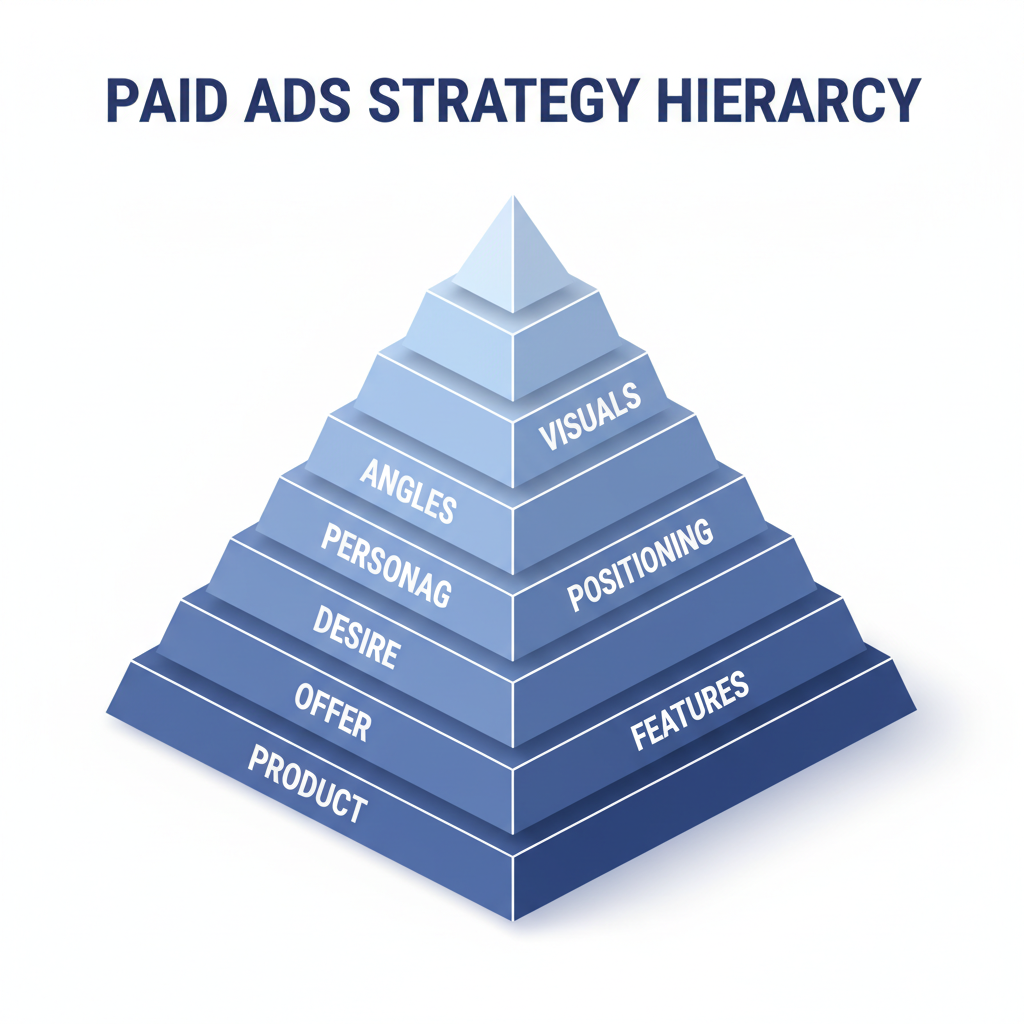
The Rule of Doubling is a strategic framework that prioritizes testing variables in a specific order of impact: Product, Offer, Desire, Features, Personas, Positioning, and Angles. By optimizing the top of the hierarchy first, advertisers can systematically double their performance metrics before moving to granular creative iterations.
Key Insights from This Guide
- Prioritize Hero Products: Focus budget on validated winners before testing slow-moving inventory.
- Craft Cold-Friendly Offers: Offers must be genetically engineered to convert cold traffic immediately.
- Ride Market Desires: Align your angles with the current 'vibe' or wave of market demand (e.g., status vs. savings).
- Diversify Personas: Scale by selling the same product to different user groups with unique pain points.
- Iterate Formats, Not Just Scripts: Turn one winning script into dozens of visual variations.
Understanding the Paid Ads Testing Strategy
Effective advertising is not about guessing; it is about scientific iteration. The core philosophy behind a robust Paid Ads Testing Strategy is to treat every test as a step toward the next winner. This approach prevents budget waste on low-impact tests.
The hierarchy of impact dictates that a better product or offer will always outperform a better button color or headline. Therefore, testing must occur in a specific sequence. Once the product and offer are maximized, the focus shifts to the psychological triggers (Desire and Angles) and finally to the visual execution.
The Rule of Doubling Framework
The 'Rule of Doubling' suggests that by optimizing each layer of the hierarchy, you open the potential to double your ad account's performance. The hierarchy flows as follows:
- Product: The foundation of all performance.
- Offer: The terms of the exchange.
- Desire: The market's current emotional wave.
- Features & Benefits: The functional value.
- Personas: Who is buying and why.
- Positioning: How the product is framed against competitors.
- Angles: The specific narrative hook.
- Visuals: The creative format (Video, Image, UGC).
Step-by-Step: Implementing the Strategy

Step 1: Select the Right Product (Hero vs. Door Opener)
Begin by analyzing your Contribution Margin 3 (CM3). Identify your 'Hero Product'—the item with validated demand that sustains the business. Do not waste test budget on 'shelf warmers' (slow movers) until the Hero Product is fully maximized. Additionally, identify your best 'Door Opener'—the product that most effectively acquires new-to-brand customers, even if it differs from your highest margin item.
Step 2: Engineer a Cold-Friendly Offer
A weak offer will suppress the performance of even the best creative. In 2025, offers must be 'Cold-Friendly,' meaning they are designed to trigger impulse purchases from strangers. Test three main offer types:
- Max Savings: High perceived value through bundling or discounts.
- Max Results: Bundles that promise a complete solution or faster outcome.
- Max Anti-Disappointment: Offers that reverse risk and guarantee satisfaction.
Step 3: Align with Market Desire
Analyze the macro-environment. Is the market currently driven by 'Status' (signaling wealth), 'Savings' (inflation concerns), or 'Self-Care'? If the general market vibe is budget-conscious, a status-focused angle will fail regardless of the ad quality. Align your narrative with the current wave of public sentiment.
Step 4: Diversify Personas and Angles
To scale beyond a plateau, you must sell the same product to new people. If you sell a beauty product, test angles for different hair types (curly vs. straight) or demographics (Gen Z vs. Mature). This allows ad platforms to find new pockets of inventory, effectively diversifying your acquisition channels within a single account.
Step 5: Creative Format Iteration
Once you have a winning concept (Product + Offer + Angle), do not reinvent the wheel. Take the winning script and produce it in multiple formats:
- UGC (User Generated Content) with different demographics.
- Founder-led explainer videos.
- AI Voiceovers over product b-roll.
- Static images and slideshows.
- Testimonial-first edits.
This method turns one winning idea into 15+ creative assets, maximizing the lifespan of a successful test.
Common Mistakes to Avoid
- Death by Testing: Running too many granular tests (like font colors) simultaneously, which dilutes budget and statistical significance.
- Pushing Shelf Warmers: Forcing products that the market doesn't want instead of scaling what is already working.
- Ignoring Post-Purchase Data: Launching new products based on founder intuition rather than customer survey data.
How AdLibrary Supports Your Testing Strategy
AdLibrary.com allows you to accelerate this testing process by researching what is working for competitors. You can search for specific brands to see how they structure their offers or filter by 'Angle' and 'Hook' to understand current market desires. By analyzing the active ads of top-performing stores, you can identify which personas they are targeting and how they iterate their winning creatives, giving you a data-backed starting point for your own Paid Ads Testing Strategy.
Key Takeaways
- Follow the hierarchy: Product > Offer > Desire > Creative.
- Only test new variables when the previous layer is optimized.
- Use data (CM3 and surveys), not gut feeling, to select products.
- Scale winners by iterating formats, not changing the core message.
Related Tools
Frequently Asked Questions
What is the Rule of Doubling in paid ads?
The Rule of Doubling is a Paid Ads Testing Strategy that organizes optimization efforts into a hierarchy (Product, Offer, Desire, etc.). By systematically perfecting each layer in order, advertisers can achieve significant performance jumps—effectively 'doubling' results—rather than seeing marginal gains from random testing.
How do I choose the best product for ads?
Focus on your 'Hero Product' first—the item with the highest existing demand and sales velocity. Analyze your CRM data to find the product with the best Contribution Margin 3 (CM3) or the one that acts as the best 'Door Opener' for new customers. Avoid testing slow-moving inventory until your main drivers are maximized.
What is a cold-friendly offer?
A cold-friendly offer is designed specifically to convert traffic that has no prior relationship with your brand. It typically includes high perceived value, risk reversal (guarantees), or bundled solutions that solve a complete problem, overcoming the skepticism and friction inherent in cold audiences.
How should I scale a winning ad creative?
Don't just increase the budget; iterate the format. Take the script or concept of the winning ad and reproduce it using different visual styles: UGC creators, founder videos, static images, AI voiceovers, or slideshows. This extends the life of the winning concept without fatiguing the audience.
Why is 'Desire' important in ad testing?
Market Desire refers to the overarching emotional 'vibe' or trend in the market (e.g., holiday gifting, summer fitness, or economic caution). Even a great product will fail if the ad's angle contradicts the current market mood. Aligning your creative with these macro-desires ensures your ads ride the wave of consumer sentiment.
Key Terms
- Hero Product
- The primary product in a catalog that drives the majority of revenue and has validated market demand, which should be the focus of acquisition campaigns.
- Cold-Friendly Offer
- A strategic offer structure designed to lower the barrier to entry for new customers through bundles, savings, or risk reversal.
- Contribution Margin 3 (CM3)
- A profitability metric that calculates revenue minus variable costs (COGS, fulfillment, payment fees) and marketing spend, indicating the true profit of a product.