Audience Overlap is the percentage of users that appear in multiple ad sets at the same time — typically driving up CPM through self-bidding and inflating frequency past target caps.
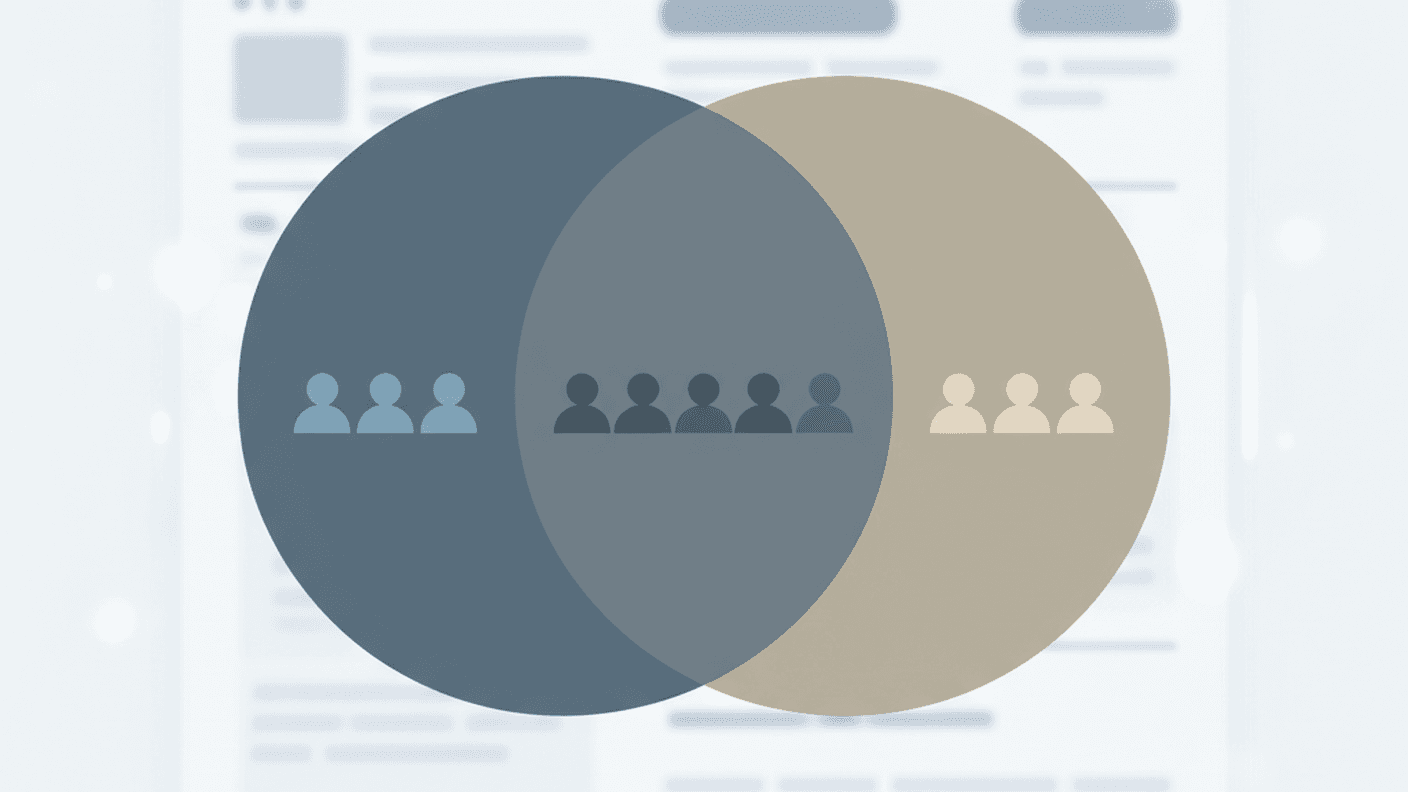
When two ad sets chase the same person in the same auction, your account has stopped competing against the market and started competing against itself. Audience overlap is the percentage of users included in more than one ad set simultaneously — and it is the most common silent cost driver in multi-ad-set accounts.
The mechanism is straightforward. Meta's auction system runs a separate bid for each eligible ad set. When one user qualifies for three of your sets, all three enter the same auction. Your own bids inflate the clearing price, CPM rises, and the winning impression often goes to whichever set has the highest effective bid rather than the highest relevance. The result: you pay more to reach the same person, frequency climbs past target, and your frequency capping settings become effectively meaningless.
This compounds at scale. Accounts running lookalike audiences in parallel tiers (1%, 2%, 5%) are almost always stacking subsets of the same pool. The 1% set is entirely contained within the 2% set; every impression won by the 1% set was also contested by the 2%. That same logic applies when you layer custom audiences alongside lookalikes without explicit exclusions: existing customers bleed into prospecting impressions, raising CPM without expanding reach.
Under Meta's Andromeda delivery architecture, the system has more latitude to serve across placements and audiences — which means overlap between broad and interest-based sets is a larger problem in 2025–2026 than it was under the prior campaign structure. When I audit accounts with heavy audience segmentation built before the consolidation push, I routinely find 30–50% overlap on the prospecting layer alone. Meta's own Audience Overlap tool (Audiences > select 2–5 audiences > Show Audience Overlap) surfaces the matrix in seconds.
If you are evaluating ai ad campaign automation, overlap detection should be on the feature checklist — automated bidding amplifies self-competition. For a detailed look at how audience structure affects performance, lookalike audience model updates in 2026 covers the mechanics directly.
Measure overlap before you consolidate. The data is free; the guess isn't.
Two ad sets bidding on the same person means your account is competing against itself. I've reviewed hundreds of accounts running 8+ ad sets and found 30%+ overlap on inspection in most of them. Fixing it usually drops CPM 15–25% and brings frequency back into target range without any budget change. The fix is structural: consolidate or add exclusions once, and the efficiency gain runs continuously.
